
At-home blood test
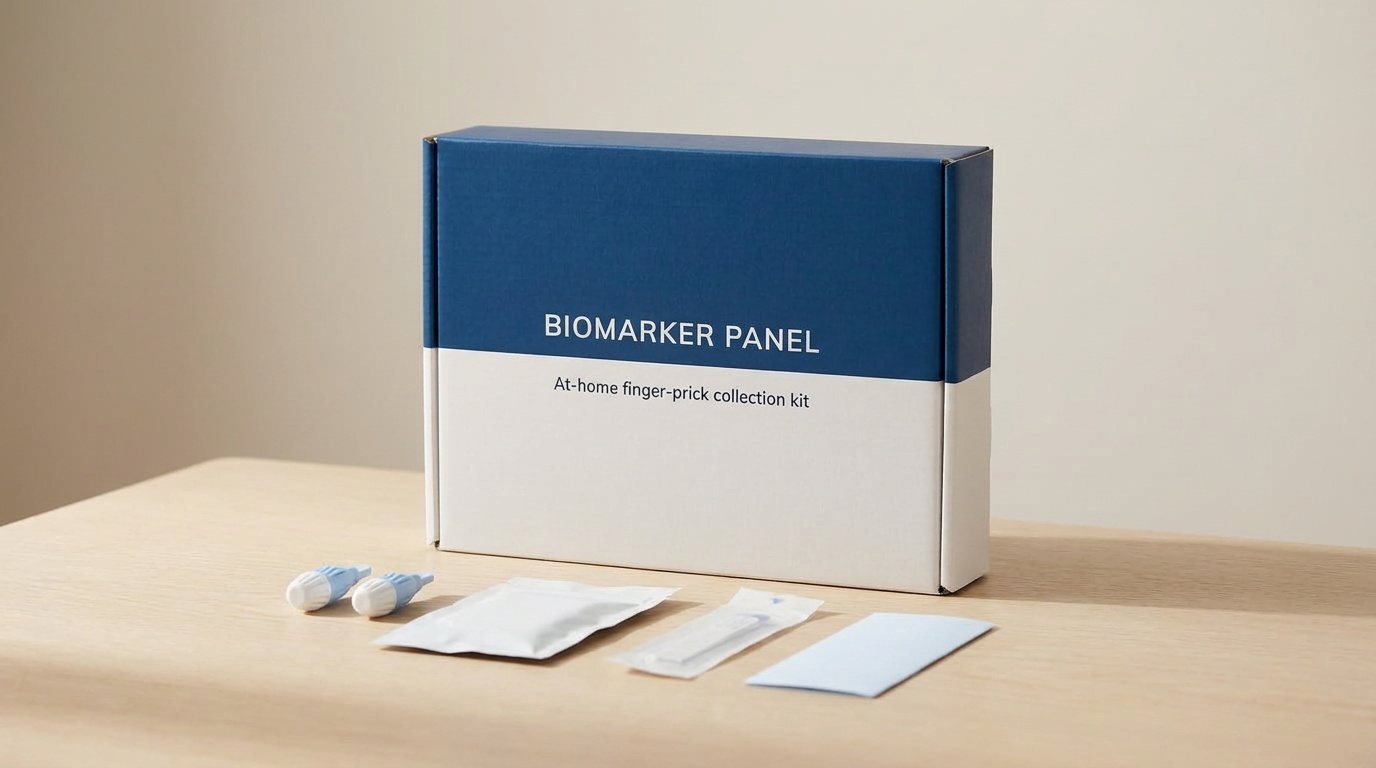
A blood test you take at home, in about ten minutes.
One small prick on your finger — no clinic, no appointment, no needle in your arm. It reads the markers in your blood and shows you the numbers, so you know what is actually going on in your body. Results come back in 3 to 5 days.
(Save yourself a trip to a clinic — or having to wait in a waiting room for hours.)
What you get
- A blood test kit you take at home.
- Your results — a panel that tells you what is going on inside your body, reviewed by a licensed clinician.
Baseline Panel · 7 markers
The peptides.io At-home Blood Test
- All in one
- Monthly delivery
- Easily skip or cancel anytime
$49.99$89.99/test$40 off first test
Shipping included
- Shipped free to your door, prepaid return envelope
- Results in 3 to 5 days, reviewed by a licensed clinician
- Easy to understand results
- The Peptide Book included
$49.99 today, then $89.99 a month. Shipping included. Skip or cancel anytime.
- Easily skip or cancel anytime
- CLIA-certified, CAP-accredited lab
- HIPAA-compliant handling
- You’re busy and never get round to booking one
- You don’t like needles
- You’ve never had your numbers checked
7markers in the $49.99 panel
10minat your kitchen table
1finger prick — no blood draw
3–5daysfor results, once the lab has it
You can’t fill a gap you’ve never seen.
Almost nothing in here announces itself. Insulin resistance builds for years without a symptom. Inflammation has no feeling attached to it. A liver under strain stays quiet until it isn’t. You find these out by measuring them, or you find them out much later.
You’d have no idea. That’s the whole point.
None of these tell you anything on their own. That is exactly why they are worth measuring.
I didn’t know I had high cholesterol — properly high, in the high-risk range — until I took a blood test. I had no symptoms. Nothing felt wrong. That test may well be the thing that saved my life later on.
Another time my skin was breaking out badly. I had a good diet, I was clean, I couldn’t work out what I was doing wrong. It turned out to be a deficiency brought on by too much stress. I would never have guessed it.
Both times, I had no idea what to fix until I measured it. That is the whole reason I recommend doing this.
The test you keep meaning to book.
Call the clinic, find a slot, take the morning off, sit in a waiting room, have a vial drawn, then wait for a call that may just say “all normal” without telling you a single number. Most people never get round to any of it.
Usually happensEventually, maybe
Ten minutes at your kitchen table.
It arrives in the post. You prick one finger, fill in the card, and drop it back in the mail in the envelope that came with it. A licensed clinician reviews your result before it is released, and it reaches you three to five days after the lab has your sample.
Usually happensThis week
| This kit | A standard lab draw | |
|---|---|---|
| No appointment to book | ● | — |
| Collected at home, on your own schedule | ● | — |
| One finger prick, not a vial of blood | ● | — |
| Prepaid return envelope included | ● | — |
| Plain unbranded packaging, prepaid return envelope | ● | — |
| Clinician approves the order and reviews the result | ● | ● |
| Processed by a CLIA- and CAP-accredited lab | ● | ● |
The last two rows are the same either way, and that is the point — this is a different way to collect the sample, not a lesser one. Accreditations are held by CLIA- and CAP-accredited partner laboratories.
Two panels. The difference is how deep you go.
Same at-home finger-prick sample either way, processed by CLIA- and CAP-accredited partner laboratories.
Most people start here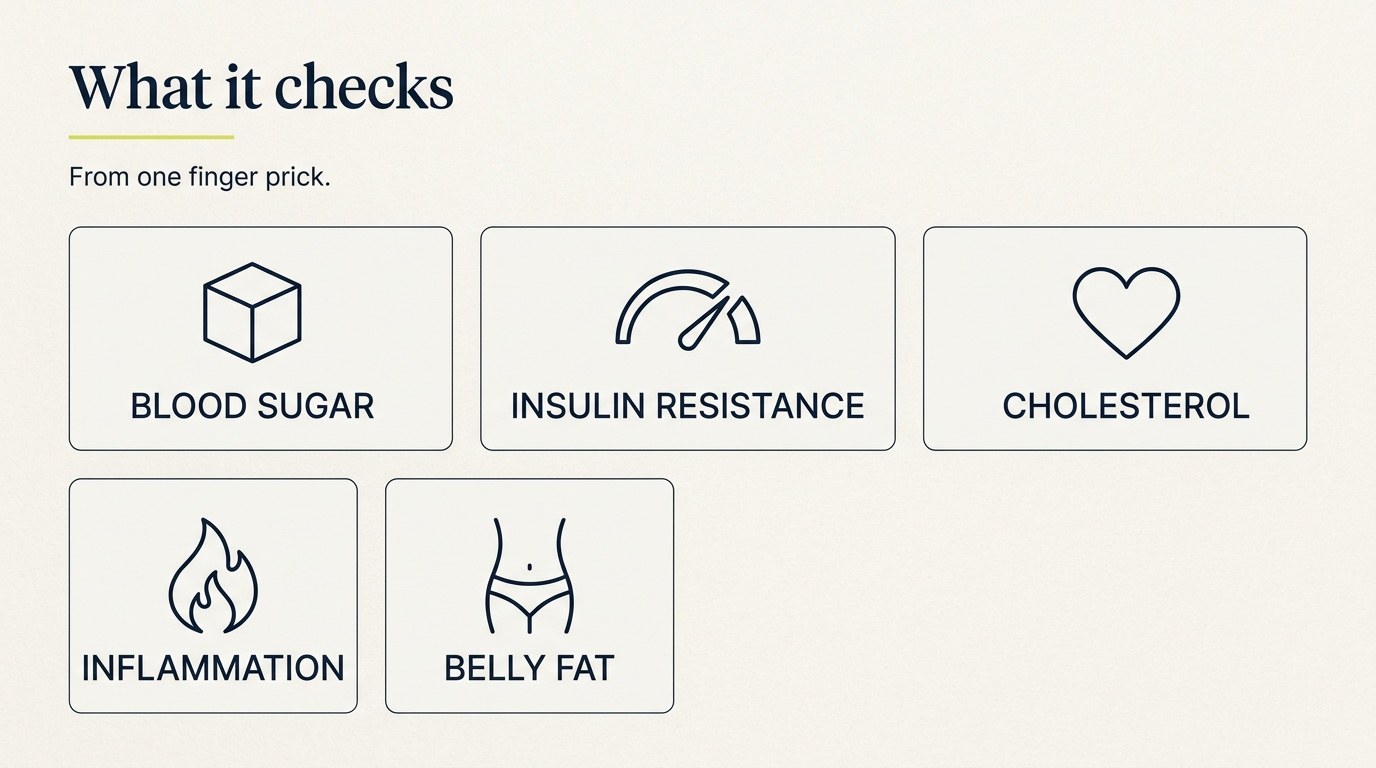
Baseline Panel
$49.99$89.99−44%
Seven markers across the metabolic and inflammatory systems — the entry point, and the fastest way to find out where you currently stand.
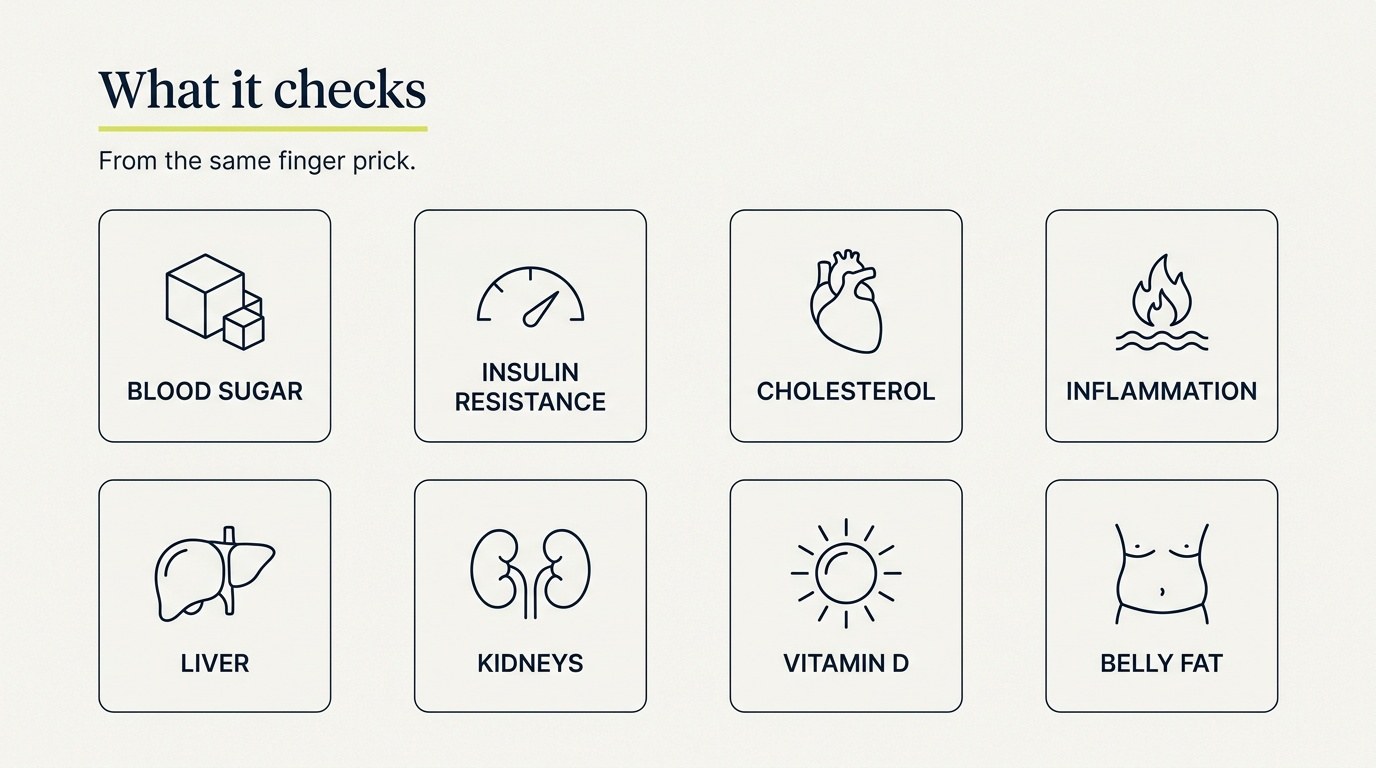
Core Panel
$149
The full picture — metabolic and inflammation, plus the liver, kidneys and vitamin D that nothing else here covers. The widest view of what is going on in the background.
| Marker | Baseline Panel | Core Panel |
|---|---|---|
| Insulin resistanceRead from your triglyceride-to-HDL ratio. It moves years before blood sugar does. | ● | ● |
| HbA1cAverage blood sugar over about three months. | ● | ● |
| Fasting glucoseBlood sugar at rest, before food. | ● | ● |
| Visceral fatFat stored around the organs rather than under the skin. | ● | ● |
| Cholesterol and lipidsTotal, HDL, LDL and triglycerides, read together. | ● | ● |
| hs-CRPBackground inflammation — the slow kind you cannot feel. | ● | ● |
| LiverThe organ processing everything you consume. | GGT only | Full panel |
| Kidney functionHow efficiently your kidneys are filtering your blood. | — | ● |
| Vitamin DThe most common deficiency there is, and rarely measured unless you ask. | — | ● |
Both read the same metabolic and inflammation markers. The $149 panel adds the liver and kidney picture and vitamin D on top — it is the wider view, not a different one.
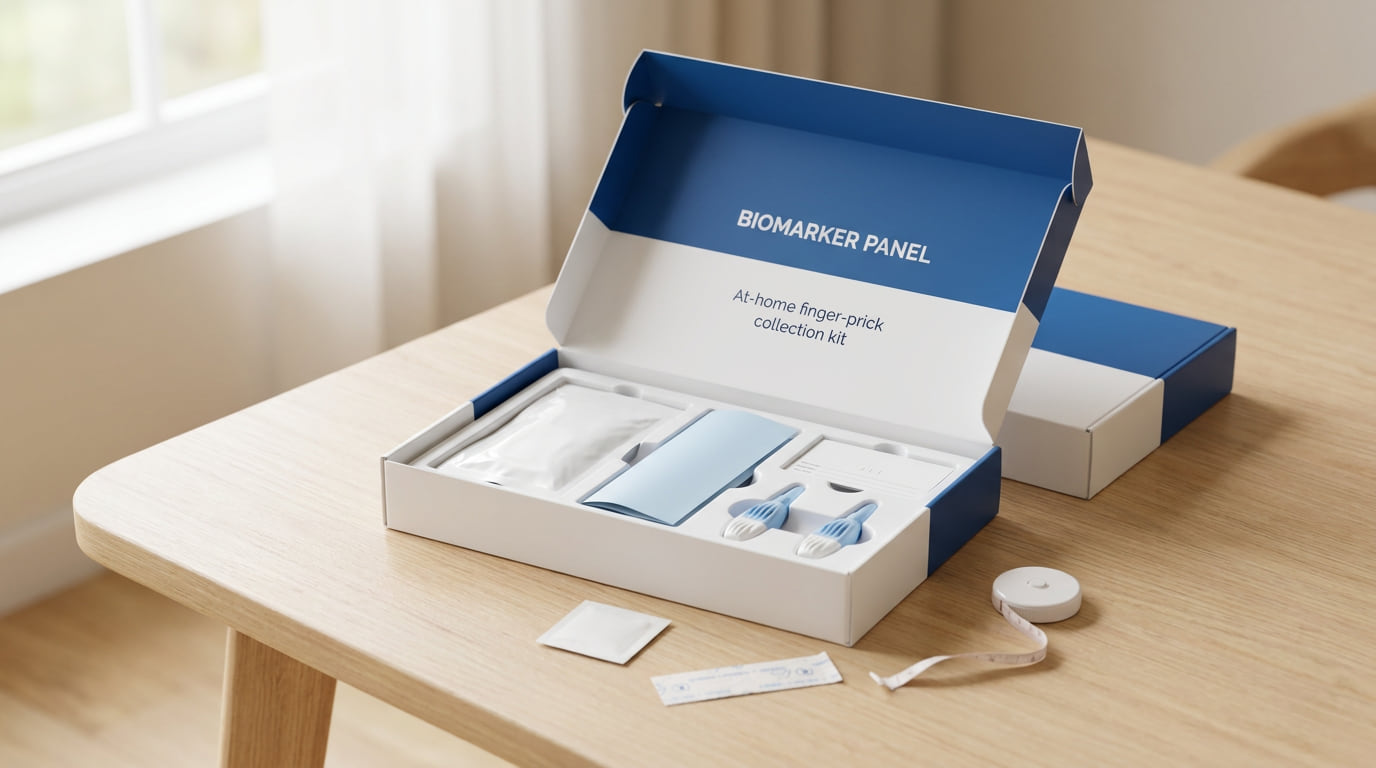
In the box
Everything you need, and nothing you don’t.
- A collection card — four large drops of blood is the entire sample.
- Two lancets — twist the top off; the second is spare, for another finger.
- An alcohol pad — to clean your fingertip before the prick.
- A sealed return bag — it holds a desiccant, so the dried card travels safely.
- A prepaid USPS envelope — postage and the lab’s address already on it.
- Step-by-step instructions — eight picture steps, written for someone who has never done this.
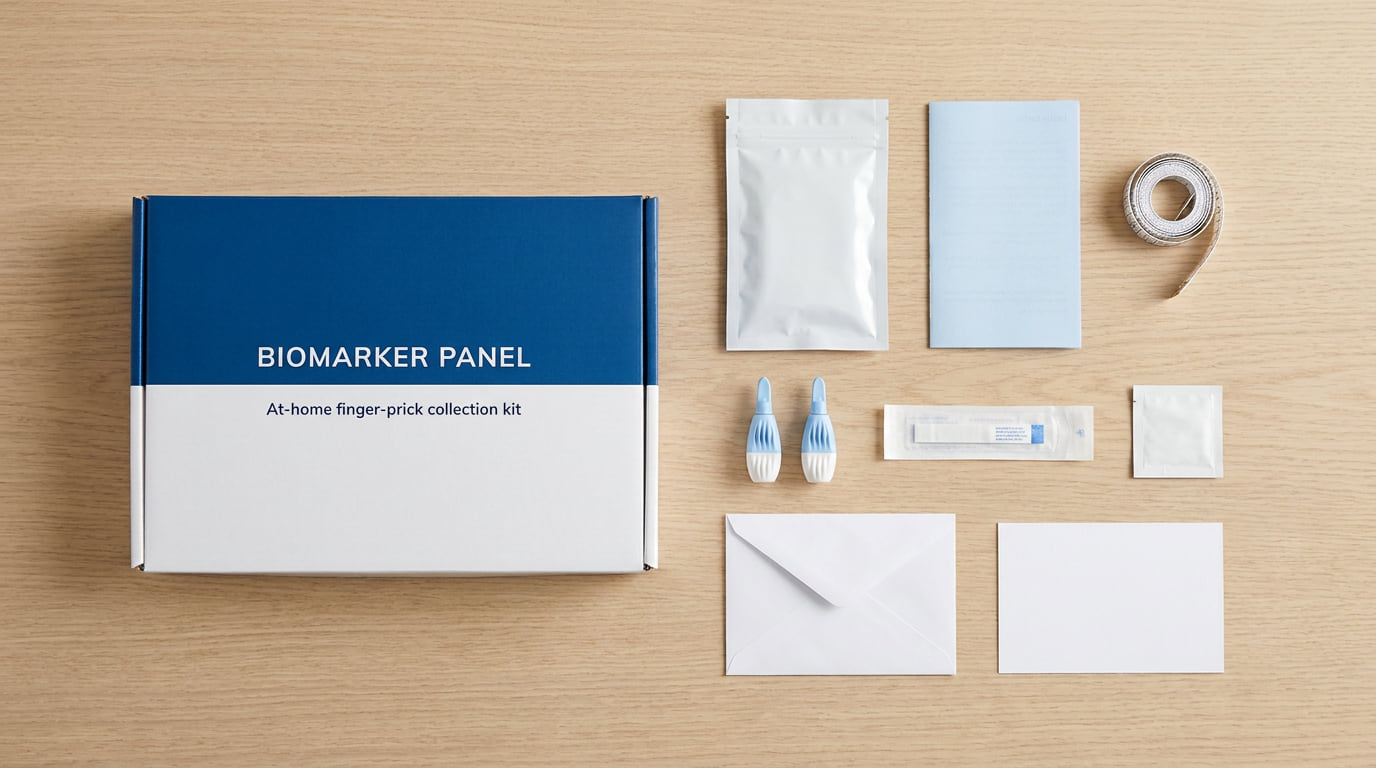
Order it, take it, post it. That’s the whole thing.
No appointment, no clinic, no blood draw — a dried blood spot from one finger prick. The only part that takes any time is the waiting.
- 01You order
Pick your panel and check out. Nothing to book, no clinic, no referral.
- 02It arrives
Drop-shipped to your door in a plain box — lancets, collection card, prepaid return envelope.
- 03One finger prick
Four large drops on the card at your kitchen table, from your non-dominant middle finger. Register the kit with the barcode in the box, using the same name you write on the card — that is how the lab matches your sample to you.
- 04You post it back
Let the card dry for 30 to 45 minutes, seal it in the bag, then into the prepaid USPS envelope. Postage is already paid.
- 05A clinician signs it off
Every order is approved by a licensed clinician before it reaches the lab, and every result is reviewed before it's released to you.
- 06Your numbers come back
3–5 days after the lab receives it. A licensed clinician reviews the result before it is released to you.
Kits arrive in 5–7 business days.
Looking for something more specific?
Two further panels, for people who already know which system they want read.
GLP-1 Panel
$149Blood sugar read together with fasting insulin, which moves first, alongside the liver, kidney and pancreas markers that standardly accompany them.
What it measures · 6 markers
Metabolic
Blood sugar, and the effort your body is spending to hold it steady.
- HbA1cYour average blood sugar over about three months — the headline number for this system.
- Fasting glucoseBlood sugar at rest, before food.
- Fasting insulinHow much insulin it takes to keep that glucose where it is. Rising insulin with normal glucose is the early signal.
Liver & kidneys
The organs that process what you consume, and the standard safety pair on any metabolic panel.
- ALT, AST and GGTLiver enzymes. They rise when liver cells are under stress.
- Creatinine and eGFRHow efficiently your kidneys are filtering your blood.
Pancreas
An organ that almost never gets measured, and one worth having on record.
- LipaseThe enzyme the pancreas makes to break down fat. It is the standard way to tell whether the pancreas is irritated.
Hormone & ED Panel
$149Total and free testosterone read together with SHBG, rather than a single number on its own, plus the prostate safety marker a clinician would want alongside it.
What it measures · 7 markers
Testosterone
Testosterone is not one number. Most tests report a single figure that can read perfectly normal while the usable portion is low.
- Total testosteroneEvery bit of it in your blood, bound and unbound together. This is the figure most tests stop at.
- Free testosteroneThe fraction actually circulating and available to your body. This is the part you feel.
- SHBGThe protein that binds testosterone up. High SHBG can leave a normal total with very little free.
The upstream signals
Hormones are a chain of instructions. These show which link the number is coming from.
- LHThe signal the pituitary sends telling the testes to produce. It separates a production problem from a signalling one.
- EstradiolConverted from testosterone by the body. Both too little and too much cause their own problems.
Safety
The markers that belong alongside any hormone picture, and the reason a clinician reads it rather than you alone.
- PSAThe standard prostate marker. It is checked as a matter of course whenever testosterone is measured.
- Visceral fatFat stored around the organs. It converts testosterone to estradiol, so it shapes the rest of this panel.
Then take it to someone who can help.
A number on its own changes nothing. What it gives you is something specific to bring to a clinician — a measurement rather than a hunch about how you’ve been feeling, and a question worth asking. What to do about it is their call, not ours.
See how easy it is.
Who handles your sample
CAPAccredited
College of American Pathologists accreditation held by the processing laboratory.
CLIACertified
Clinical Laboratory Improvement Amendments certification — the federal standard every US clinical lab is held to.
HIPAACompliant
Your result is health data and is handled under HIPAA privacy protocols.
ClinicianReviewed
A licensed clinician approves the order before the lab runs it, and reviews the result before release.
Your sample is processed by an accredited partner laboratory, and these accreditations are held by that laboratory. peptides.io is not a laboratory and not a medical provider. We ship to every US state except New York, New Jersey, Rhode Island, which restrict at-home lab testing.
Common questions
Do I have to test monthly?
We’re a monthly subscription, but you have full flexibility. You can skip up to 3 months at a time or cancel anytime directly from your account. We recommend completing at least 3 tests to set an accurate baseline before skipping. You won’t be charged for any months you choose to skip.
Can I cancel my subscription without fees?
Yes. You can cancel anytime, without any fees, from your account. Nothing more is charged and your results stay in your account.
How often is best to test?
We recommend testing every month, but you’re free to skip up to 3 months between tests if you prefer a more quarterly pace.
Is this a diagnosis?
No. It’s a measurement. A panel tells you where your numbers sit; what to do about them is a conversation with a clinician, and we’d always tell you to have that conversation rather than act on a number alone.
Why not just get a standard physical?
A routine physical is looking for whether anything is wrong today. These panels measure the systems that move slowly in the background — insulin resistance, hs-CRP, the full testosterone picture with SHBG, liver enzymes. Several of those are not on a standard panel at all, and the ones that are rarely come back with an explanation of what they mean.
Should I test again later?
That’s the point of a baseline. One reading tells you where you stand; a second, a few months into whatever you decide to do, tells you whether it worked. Without the first number the second means very little.
Does it hurt?
It’s a finger prick, not a blood draw. Most people describe it as less than a paper cut, and it’s over in a second.
Who actually runs the test?
The sample is processed by CLIA- and CAP-accredited partner laboratories, and a licensed clinician reviews your result before it is released to you. peptides.io sells the panel and handles your order — we are not a laboratory, we are not a medical provider, and we do not see your marker values.
What if I change my mind?
Cancel any time before your kit ships and we refund you in full. Once it has shipped the kit can't be reused, so it isn't refundable.
Find out what’s actually going on.
One finger prick at your kitchen table. No appointment, no clinic, and a licensed clinician reviewing the result before it reaches you.
$49.99$89.99first kit
Then $89.99 a month, shipping included. Skip or cancel anytime.
These panels are for information, not diagnosis. They are not a substitute for care from a licensed clinician, and nothing on this page is medical advice. peptides.io does not operate a laboratory; samples are processed by CLIA- and CAP-accredited partner laboratories.