
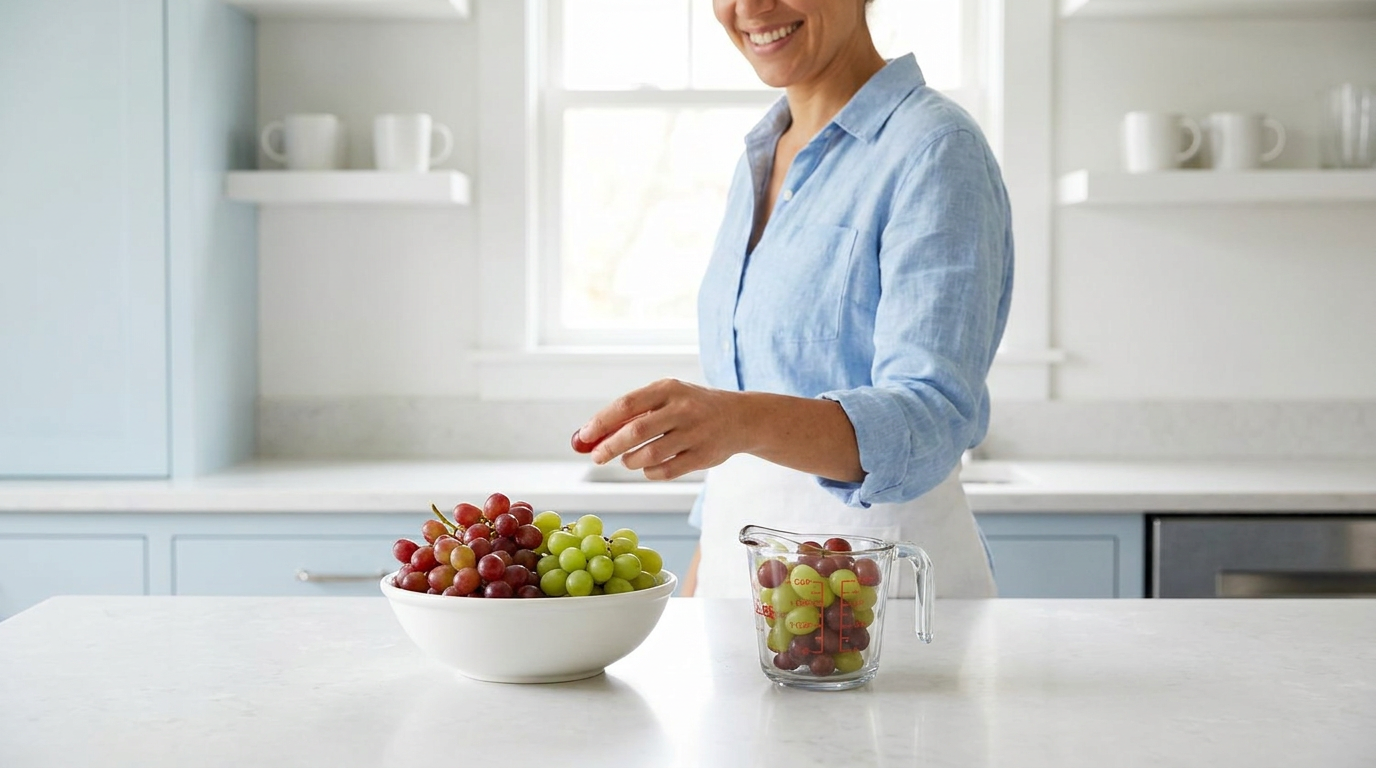
- A cup of grapes (151 g) has 104 calories, 100 g has 69 and one grape about 3.4, in USDA data for the raw red or green fruit [15]. About 30 grapes make 100 calories [15].
- Grapes are 80.5% water, with 23.4 g of natural sugar, 1.4 g of fiber and 1.1 g of protein per cup [15]. Copper (21% of the Daily Value) and vitamin K (18%) are their richest nutrients [9, 15].
- Yes, grapes are good for you as a nutritious, mostly water fruit, but most health claims rest on small, sometimes industry-funded studies [2, 3]. A 500 mg resveratrol trial dose would take about 2,200 cups of black grapes [5, 14].
- Grapes can be part of a weight-loss or diabetes meal plan in measured portions. About 17 grapes contain 15 g of carbohydrate, and three fresh varieties tested at a glycemic index of 50 to 59 [7, 22].
Calories in grapes look simple until you compare sources. USDA's own entries range from about 62 to 125 calories per cup, depending on the entry and the cup weight it uses [15].
Read on for counts by the piece and by the cup, full nutrition facts, how the colors compare, and what research says about benefits, weight loss and blood sugar.
How many calories in grapes per grape and per cup?
A cup of grapes has 104 calories, 100 g has 69 and a single piece about 3.4, in USDA's standard entry for the raw red or green fruit [15]. That entry weighs a cup at 151 g and an average piece at 4.9 g [15]. Use the per-100 g figure if you weigh your portion on a kitchen scale.
Size varies from bunch to bunch, so these counts are averages. Bigger ones weigh more, so weigh a few if you track closely.
| Serving | Weight | Calories |
|---|---|---|
| 1 grape | 4.9 g | 3.4 |
| 10 grapes | 49 g | 34 |
| 20 grapes | 98 g | 68 |
| 30 grapes | 147 g | 101 |
| 1/2 cup | 75.5 g | 52 |
| 3/4 cup (label serving) | 126 g | 87 |
| 1 cup | 151 g | 104 |
Table: Calories in raw grapes by count and cup. Source: USDA FoodData Central SR Legacy entry 174683, grapes, red or green (European type), raw [15]. Grape counts use USDA's 10 grapes = 49 g. The 3/4 cup label serving is FDA's raw-fruit label serving [17].
About 30 grapes add up to 100 calories, USDA data show: 29.6 pieces, or 145 g [15]. That amount is just under 1 cup [15]. Counting out 30 is an easy way to cap a snack near 100 calories [15].
Twenty grapes have about 68 calories, and 10 have about 34 [15]. USDA lists no weight for a handful, so counting gives a more reliable number than guessing.
No, seedless grapes are not proven to have fewer calories: USDA has no matched seeded and seedless pair to compare [15]. For comparison, USDA's separate muscadine entry has 57 calories per 100 g, compared with 69 for the standard red or green entry, and 3.9 g of fiber [15].
Why do some sites say a cup of grapes has 62 calories?
A 62-calorie figure for a cup of grapes matches USDA's American type (slip skin) entry, which weighs a cup at only 92 g, not 151 g [15]. That entry's average piece weighs 2.4 g, so it lists just 1.6 calories each [15].
Slip-skin grapes and the standard red or green entry have similar calories per gram in USDA data: 67 and 69 per 100 g [15]. Cup weight, not the fruit, explains most of the gap. Check the gram weight behind any app entry before you trust its cup count.
USDA's newer lab-tested samples (Foundation Foods) list more calories than the standard entry [15]. Red seedless lab samples have 77.2 calories per 100 g, about 12% more, and green seedless have 71.9, about 4% more [15]. The lab samples list no fiber or vitamin K, so the standard entry stays more complete [15].
USDA's food survey database (FNDDS) lists 124.5 calories per cup because it uses general calorie factors, giving 83 per 100 g [15]. It also assumes a larger 7 g piece, so each one shows 5.8 calories [15]. We lead with the standard entry because it has the fullest nutrient panel, including fiber and vitamin K.
| USDA entry | Cup weight | Calories per cup | Calories per grape |
|---|---|---|---|
| Red or green, standard (SR Legacy 174683) | 151 g | 104 | 3.4 (4.9 g grape) |
| American type, slip skin (SR Legacy 174682) | 92 g | 62 | 1.6 (2.4 g grape) |
| Red seedless, lab samples (Foundation 2346412) | 151 g | 116.5 | 3.8 (4.9 g grape) |
| Green seedless, lab samples (Foundation 2346413) | 151 g | 108.6 | 3.5 (4.9 g grape) |
| Survey database (FNDDS 2709237) | 150 g | 124.5 | 5.8 (7 g grape) |
Table: Why a cup of grapes can show 62 to 125 calories. Source: USDA FoodData Central, SR Legacy 2018, Foundation Foods April 2022 and FNDDS 2021-2023 [15]. Foundation entries list no portions, so the standard 151 g cup and 4.9 g grape are applied.
What are the nutrition facts for grapes?
In USDA data, a cup of grapes has 104 calories, 27.3 g of carbohydrate, 23.4 g of sugar, 1.4 g of fiber and 1.1 g of protein [15]. Fat and sodium are close to zero [15]. Nearly all of the calories come from carbohydrates.
Grapes are 80.5% water by weight in USDA data, which explains their juicy bite and their low 0.69 calories per gram [15]. Raisins, the same fruit dried, are only 15.5% water [15]. Losing that water is why raisins pack far more calories per gram.
| Nutrient | Per cup (151 g) | % Daily Value | Per 100 g |
|---|---|---|---|
| Calories | 104 | Not applicable | 69 |
| Total carbohydrate | 27.3 g | 10% | 18.1 g |
| Total sugars | 23.4 g | No Daily Value | 15.5 g |
| Dietary fiber | 1.4 g | 5% | 0.9 g |
| Protein | 1.1 g | 2% | 0.7 g |
| Total fat | 0.2 g | Under 1% | 0.2 g |
| Sodium | 3 mg | Under 1% | 2 mg |
Table: Grape nutrition facts per cup, calories and macronutrients. Source: USDA FoodData Central SR Legacy 174683 [15]. % Daily Value uses FDA Daily Values for a 2,000-calorie diet: carbohydrate 275 g, fiber 28 g, protein 50 g, fat 78 g, sodium 2,300 mg [9]. Sugars in whole grapes are not added sugars, so no Daily Value applies.
| Nutrient | Per cup (151 g) | % Daily Value |
|---|---|---|
| Copper | 0.19 mg | 21% |
| Vitamin K | 22 mcg | 18% |
| Thiamin (vitamin B1) | 0.10 mg | 9% |
| Riboflavin (vitamin B2) | 0.11 mg | 8% |
| Vitamin B6 | 0.13 mg | 8% |
| Potassium | 288 mg | 6% |
| Vitamin C | 4.8 mg | 5% |
Table: Grape vitamins and minerals per cup. Source: USDA FoodData Central SR Legacy 174683 [15]. FDA Daily Values: copper 0.9 mg, vitamin K 120 mcg, thiamin 1.2 mg, riboflavin 1.3 mg, vitamin B6 1.7 mg, potassium 4,700 mg, vitamin C 90 mg [9].
Only copper and vitamin K in grapes top 10% of the FDA Daily Value per cup in USDA data: copper at 21% and vitamin K at 18% [9, 15]. Every other vitamin and mineral is under 10% [9, 15]. Vitamin C, often linked with fruit, is only 5% [9, 15].
Grapes have very little protein: 1.1 g per cup, or 2% of the FDA Daily Value, in USDA data [9, 15]. Half a cup has about 0.5 g [15].
Grapes are not a high-fiber fruit, with 1.4 g per cup, or 5% of the FDA Daily Value [9, 15]. See how much fiber grapes have compared with other fruits.
Grapes are not high in potassium: a cup has 288 mg, or 6% of the FDA Daily Value, in USDA data [9, 15]. A half cup has 144 mg [15]. Portion size matters most if your potassium is limited.
Do red, green, black and Cotton Candy grapes have different calories?
Red, green and black grapes differ mainly in skin pigment, not calories [14, 15]. USDA's newer lab-tested samples list 77.2 calories per 100 g for red seedless and 71.9 for green seedless, a gap of about 8 per cup [15]. USDA reports no calorie figure for black varieties [15].
Green grapes do not have more sugar than red ones. USDA's newer lab-tested samples show 16.1 g of sugar per 100 g for green seedless and 17.3 g for red seedless [15]. In both, the sugar is fructose and glucose, with sucrose measured at zero [15].
| Grape type | Calories | Sugar | Anthocyanins | Data source |
|---|---|---|---|---|
| Red or green, standard | 69 | 15.5 g | Not measured | USDA SR Legacy 174683 |
| Red seedless | 77.2 | 17.3 g | Not measured | USDA Foundation 2346412 |
| Green seedless | 71.9 | 16.1 g | None listed | USDA Foundation 2346413; Phenol-Explorer |
| Black | Not reported | Not reported | About 72 mg | Phenol-Explorer |
| American type, slip skin | 67 | 16.2 g | Not measured | USDA SR Legacy 174682 |
| Cotton Candy | No USDA entry | 19.2 °Brix (juice reading, not grams) | Not measured | U.S. Plant Patent PP23,399 |
Table: Grape colors and types compared, per 100 g. Source: USDA FoodData Central [15]; Phenol-Explorer 3.6, black grape and green grape [14]; U.S. Plant Patent PP23,399 [6]; International Fruit Genetics for the Cotton Candy trade name [10]. °Brix measures dissolved sugar in juice and does not convert to grams per 100 g of fruit.
In the Phenol-Explorer database, black varieties carry about 72 mg of anthocyanins (red, purple and blue plant pigments) per 100 g, and green varieties have none listed [14]. Anthocyanins are a type of polyphenol [14].
Black grapes get their dark color mostly from one anthocyanin, malvidin-3-glucoside, at about 39 mg per 100 g [14]. A full cup carries about 109 mg of anthocyanins in total, in Phenol-Explorer data [14]. Black varieties also have more total polyphenols than green: about 185 mg per 100 g, compared with 122 mg [14].
Red and black grapes are not proven healthier than green ones in human studies. Black varieties carry anthocyanins that green ones lack in Phenol-Explorer data [14], but no large trial has compared colors for a health outcome. Pick the color you enjoy, since calories and sugar are close [15].
Are Cotton Candy grapes healthy, or are they genetically modified?
Cotton Candy grapes have no USDA nutrition entry, so no published data show they are healthier or less healthy than other green varieties [15]. They are a conventionally bred green seedless variety, not a genetically modified one [6]. Sold under the name Cotton Candy, the variety is patented as IFG Seven by International Fruit Genetics [6, 10].
The IFG Seven patent describes a hand-pollinated cross of a breeding selection and the Princess variety, made in May 2003, and no genetic engineering [6]. Its juice read about 19.2 °Brix (a sugar reading for juice), and its flavor is described as similar to toffee or cotton candy [6]. For calories, check the package label if it lists Nutrition Facts.
Are grapes good for you? What the research shows
Yes, grapes are a nutritious fruit, but their benefits for blood pressure, blood sugar, weight, blood vessels and aging are not proven in people. The strongest human data are links between eating fruit and better health, plus small grape powder trials [2, 3, 4, 13]. The claims table ranks each by the type and size of study behind it.
Eating grapes every day fits a healthy eating pattern for most people when the portion is measured [16]. The Dietary Guidelines for Americans, 2025 to 2030, also advise eating fruit whole, in its original form [16].
| Claim | What studies in people show | How strong |
|---|---|---|
| Lower blood pressure | A 2023 review of 30 trials: systolic pressure 3.17 mmHg lower with grape products; grape juice showed no effect | Research suggests a small effect; low certainty |
| Lower type 2 diabetes risk | 187,382 US adults: 3 servings a week of grapes or raisins linked to 12% lower risk | Observational: a link, not proof |
| Less weight gain | 133,468 US adults: each added daily serving of grapes or raisins linked to 0.70 lb less gain over 4 years | Observational: a link, not proof |
| Better blood vessel function | One trial in 24 men with metabolic syndrome, 46 g of grape powder daily for 30 days; funded by the California Table Grape Commission | Small, single, industry-funded trial |
| Resveratrol and aging | A cup of black grapes has about 0.23 mg; trials most often used 500 mg | Grapes supply too little to matter |
| Brain, gut, eye or skin health | No large trials of whole grapes in people | There's no strong evidence yet |
Table: Grape health claims ranked by strength of human evidence (ranked by study type and size). Sources: Ashoori et al. 2023 [2]; Muraki et al. 2013 [13]; Bertoia et al. 2015 [4]; Barona et al. 2012 [3]; Phenol-Explorer [14] and Brown et al. 2024 [5]. Cohort figures count grapes and raisins as one food.
The pros of grapes are 80.5% water, plus copper (21% of the FDA Daily Value per cup) and vitamin K (18%) in USDA data [9, 15]. Black varieties add about 109 mg of anthocyanins per cup [14]. The cons are only 1.4 g of fiber and 1.1 g of protein per cup, and 104 calories that go down easily [15].
| Pro or con | Per cup (151 g) |
|---|---|
| Pro: water | 80.5% water by weight |
| Pro: copper | 0.19 mg, 21% of the Daily Value |
| Pro: vitamin K | 22 mcg, 18% of the Daily Value |
| Pro: anthocyanins | About 109 mg (black varieties) |
| Con: fiber | 1.4 g, 5% of the Daily Value |
| Con: protein | 1.1 g, 2% of the Daily Value |
| Con: calories | 104 calories, easy to finish |
Table: Pros and cons of grapes per cup. Source: USDA FoodData Central SR Legacy 174683 [15]; FDA Daily Values [9]; Phenol-Explorer 3.6, black grapes [14].
Do grapes lower blood pressure?
Grapes are not proven to help your heart: in a 2023 review of 30 randomized trials, grape products lowered systolic blood pressure, one heart health marker, by 3.17 mmHg [2]. The review rated that evidence low certainty [2]. Systolic pressure is the top number in a blood pressure reading.
In the 2023 review, whole-grape forms such as raisins and grape powder lowered systolic pressure by 2.69 mmHg [2]. Grape juice showed no effect, and diastolic pressure (the bottom number) did not change [2]. Blood vessel function and heart rate did not change either [2].
The California Table Grape Commission funded a 2012 trial in 24 men with metabolic syndrome, a group of risk factors for heart disease and diabetes [3]. The men took 46 g of grape powder a day for 30 days, equal to about 252 g, or 1.7 cups, of fresh fruit [3, 15].
In that 2012 trial, systolic pressure averaged 122 mmHg on grape powder and 128 mmHg on placebo [3]. Flow-mediated dilation (how much an artery widens when blood flow rises) was 5.7% on grape powder and 4.0% on placebo [3]. One small, industry-funded trial cannot prove a benefit, and the 2023 review found no overall change in blood vessel function [2].
Do grapes give you resveratrol like red wine?
No, grapes give you very little resveratrol. Phenol-Explorer lists about 0.23 mg per cup for black varieties and 0.03 mg for green [14]. Even its highest listed value for black varieties is about 0.88 mg per cup [14].
We calculated that a typical 500 mg trial dose of resveratrol would take about 2,200 cups of black grapes, or about 333 kg [5, 14]. A 2024 review of human resveratrol trials found 500 mg a day was the most common dose [5]. Green varieties would take about 16,600 cups [5, 14].
Resveratrol supplements are a separate question from eating fruit, since trial doses ranged from 5 to 5,000 mg a day [5]. Grape seed extract is also a different product from the fresh fruit.
Keep reading • High-volume, low-calorie foods: Foods that fill a plate for fewer calories. • Healthy snacks for weight loss: Snack ideas that pair fruit with protein and fiber. • Protein powder guide: How protein powders compare and who might use one.
Are grapes good for weight loss?
Grapes are not fattening in measured portions, at 0.69 calories per gram in USDA data, so you can eat them while trying to lose weight [15]. That is a low calorie density, but a full cup still has 104 calories [15]. Measured portions keep those calories predictable.
A 1986 to 2010 study of 133,468 US adults tied each added daily serving of grapes and raisins, counted together, to 0.70 lb less gain per 4 years [4]. Total fruit showed a smaller link, 0.53 lb per serving [4]. The study was observational, so it shows a link, not proof.
A portion of 20 adds about 68 calories, under 5% of a 1,500-calorie day [15]. A full cup adds 104 [15]. Either amount works best when you count it in your daily total.
For people taking a GLP-1 medication such as Wegovy® (semaglutide) or Zepbound® (tirzepatide), grapes are an ordinary fruit snack, with no proven special benefit or harm. As of October 2026, no study has tested them alongside these medications.
A 2025 joint nutrition advisory for clinicians treating people on these medications advises enough protein, fluids and fiber from foods [12]. The advisory comes from the American College of Lifestyle Medicine, American Society for Nutrition, Obesity Medicine Association and The Obesity Society [12].
The advisory notes a proposed protein target of 1.2 to 1.6 g per kilogram daily, during weight loss, or a simpler fixed target of 80 to 120g a day [12]. It also advises checking how many fruits and vegetables a person eats [12].
A cup of the fruit adds 1.1 g of protein and 1.4 g of fiber, so protein needs to come from other foods [15].
How many grapes are in a serving, and how do you keep portions in check?
One serving of grapes is 1 cup, about 31 pieces, under the Dietary Guidelines for Americans, 2025 to 2030 [15, 16].
The Dietary Guidelines for Americans, 2025 to 2030, set 2 cups of raw fruit a day, or 2 servings, for a 2,000-calorie diet [16]. Two cups would be about 302 g and 208 calories [15].
FDA's raw-fruit label serving is smaller, at 3/4 cup (126 g) [17]. USDA data give that portion about 87 calories, which the label rounds to 90 [15, 17]. Either measure works if you use the same one every time.
- Measure one serving. Fill a 1-cup measure, one Dietary Guidelines fruit serving, to see what 104 calories of grapes looks like, then use the same bowl next time [15, 16].
- Portion before you eat. Put one serving in a bowl instead of eating from the bag or bunch.
- Wash grapes just before eating. FDA advises rinsing produce under running water, without soap or produce wash, then drying it with a clean cloth or paper towel [18].
- Freeze grapes for a cold snack. After washing and drying, spread them in one layer on a tray, freeze them until firm, then store them in a sealed container.
- Pair grapes with protein, such as Greek yogurt, cheese or a few nuts, to stay full. A cup has only 1.1 g of protein in USDA data [15]. As of October 2026, we found no study testing which foods keep you fullest alongside them. See high-protein foods for ideas.
- Keep them cold. Store grapes in the refrigerator at 40 °F or below, as FDA advises for produce [18].
Are grapes high in sugar, and can people with diabetes eat them?
Grapes are high in sugar, with 23.4 g per cup in USDA data, more than a cup of banana or blueberries [15]. The sugar is natural, not added: mostly fructose (12.3 g) and glucose (10.9 g) [9, 15]. People with diabetes can eat counted portions, but a cup is hard to fit on a strict keto diet [7, 8, 15].
People with diabetes can count 17 small grapes (3 oz) as one carb choice, about 15 g of carbohydrate, on the CDC's carb-counting list [7]. USDA data agree: 83 g of the fresh fruit has 15 g [15].
Grapes do not spike blood sugar the way pure glucose does: three Australian varieties tested at a glycemic index (GI) of 50 to 59 in the University of Sydney’s lab, compared with 100 for glucose [22]. In the University of Sydney GI database, Crimson seedless tested at 50, green seedless (Menindee) at 54 and black Waltham Cross at 59 [22].
GI compares a food's 2-hour blood sugar response with that of pure glucose [22]. Each test used 10 to 11 healthy adults [22].
Calculated from USDA carbohydrate data, glycemic load (GL) is about 13 to 15 for a full cup and 4 to 5 for a portion of 10 [15, 22]. GL adds portion size to GI, and a lower GL means a smaller expected rise in blood sugar.
A cup has 27.3 g of carbohydrate, which works out to about 1.8, or close to 2, carb choices at 15 g each [7, 15]. For meal planning, see our guide to type 2 diabetes.
| Portion | Weight | Carbs | Net carbs | Carb choices | Glycemic load (GL) |
|---|---|---|---|---|---|
| 10 grapes | 49 g | 8.9 g | 8.4 g | 0.6 | 4 to 5 |
| 1/2 cup | 75.5 g | 13.7 g | 13.0 g | 0.9 | 6 to 8 |
| 17 small grapes (CDC carb choice) | 83 g | 15.0 g | 14.3 g | 1.0 | 7 to 8 |
| 1 cup | 151 g | 27.3 g | 26.0 g | 1.8 | 13 to 15 |
Table: Grapes and blood sugar by portion. Source: USDA FoodData Central SR Legacy 174683 [15]; CDC carb choices of 15 g [7]; GI of 50 to 59 from the University of Sydney GI database [22]. Net carbs, carb choices and GL are our calculations from these data. The CDC lists 17 small grapes as 3 oz; USDA data put 15 g of carbohydrate at 83 g.
Is grape juice as healthy as whole grapes?
No, 100% grape juice is not as healthy as whole grapes. Eating them or raisins 3 servings a week was linked to 12% lower type 2 diabetes risk, and fruit juice to 8% higher risk, in 187,382 US adults [13]. Those adults were in 3 large US cohorts (groups of people followed over time), tracked between 1984 and 2009 [13].
The cohort results are links, not proof. A cup of unsweetened grape juice has 152 calories, 35.9 g of sugar and 0.5 g of fiber in USDA data [15]. Juice has about 1.5 times the calories of a fresh cup, which has 104 [15].
The Dietary Guidelines for Americans, 2025 to 2030, say 100% juice should be consumed in limited portions or diluted with water [16].
Are grapes keto-friendly?
Grapes are not keto-friendly in typical portions: in USDA data, a cup has 26.0 g of net carbs, or 27.3 g total minus 1.4 g of fiber before rounding [15]. Very low-carb keto diets limit carbohydrate to 20 to 50 g a day, according to StatPearls, so a cup uses over half of even 50 g [8, 15].
A portion of 10 has 8.4 g of net carbs, and a single piece has less than 1 g [15]. For lower-carb choices, see keto diet foods. A cup of strawberry halves has 11.7 g of carbs [15].
How do grapes compare with raisins, juice and other fruits?
Grapes have more calories per cup than strawberries, apples or blueberries, fewer than bananas or grape juice, far fewer per gram than raisins, and the same when frozen [15]. A cup has 104 calories, compared with 49 for strawberries, 65 for chopped apple, 84 for blueberries and 134 for sliced banana, in USDA data [15].
| Food (USDA serving) | Calories | Sugar | Fiber |
|---|---|---|---|
| Grapes (1 cup, 151 g) | 104 | 23.4 g | 1.4 g |
| Raisins (1/4 cup, 36 g) | 108 | 23.6 g | 1.6 g |
| Grape juice, unsweetened (1 cup, 253 g) | 152 | 35.9 g | 0.5 g |
| Apple with skin, chopped (1 cup, 125 g) | 65 | 13.0 g | 3.0 g |
| Banana, sliced (1 cup, 150 g) | 134 | 18.3 g | 3.9 g |
| Strawberries, halves (1 cup, 152 g) | 49 | 7.4 g | 3.0 g |
| Blueberries (1 cup, 148 g) | 84 | 14.7 g | 3.6 g |
Table: Grapes compared with raisins, juice and other fruits. Source: USDA FoodData Central SR Legacy entries 174683, 168165, 173042, 171688, 173944, 167762 and 171711 [15]. Cup weights differ by fruit.
Raisins have about 4.3 times the calories per gram of fresh grapes because drying removes most of the water [15]. In USDA data, raisins are 15.5% water with 299 calories per 100 g, compared with 80.5% water and 69 calories when fresh [15]. One raisin has about 1.6 calories [15].
No, frozen grapes are not lower in calories, because freezing does not change their sugar or fat. USDA lists no separate entry for the frozen fruit [15]. Wash and dry them before freezing, as the portion steps describe.
Strawberries and blueberries are better weight-loss picks than grapes on fiber per calorie, with 6.3 g and 4.2 g per 100 calories compared with 1.3 g [15]. By the same calculation from USDA data, apples have 4.6 g and bananas 2.9 g per 100 calories [15].
A cup of chopped apple has fewer calories (65) and more fiber (3.0 g); see calories in an apple [15]. A cup of sliced banana has more calories (134) and 3.9 g of fiber; see calories in a banana [15]. Both count as fruit servings under the Dietary Guidelines [16].
Who should be careful with grapes?
Grapes are safe for most people, and eating too many mainly adds calories and sugar, but four groups should take extra care:
- Babies and young children: Whole grapes are a choking hazard, the American Academy of Pediatrics (AAP) says [1]. Round, firm foods can be served if completely chopped into tiny pieces, and the AAP advises waiting until age 4 or older for high-risk foods, depending on development [1].
- People with IBS (irritable bowel syndrome): A December 2022 Monash University blog reported that retested grapes showed more fructose, one of the FODMAP carbs, than earlier tests [11]. On a low-FODMAP diet, check the Monash FODMAP app for the current serving size.
- People counting carbs for diabetes: A cup has 27.3 g of carbohydrate [15]. The CDC counts 17 small grapes as one carb choice [7].
- People on a potassium-restricted diet: Grapes can fit this diet in measured portions: in USDA data, a cup has 288 mg of potassium and a half cup 144 mg [15]. Ask your kidney care team what portion suits your limit.
Eating too many grapes mainly adds calories and sugar: two cups have about 208 calories and 46.7 g of sugar in USDA data [15]. That amount is the full daily fruit target at 2,000 calories [16]. The sugar is natural, but it still counts toward your carbohydrate total.
Grapes are not proven to make you poop: we found no study testing them as a laxative, and a cup has only 1.4 g of fiber in USDA data [15]. They have slightly more fructose (12.3 g per cup) than glucose (10.9 g) [15]. Fructose is one of the FODMAP carbs that Monash University tests for people with IBS [11].
Are grapes safe to eat right now?
Yes, as of October 1, 2026, there is no active FDA recall of fresh whole grapes and no open FDA outbreak investigation involving them [20, 21]. That status comes from FDA's recall database and its outbreak investigation table [20, 21].
As of October 1, 2026, grapes are not among the produce FDA names as linked to past US outbreaks of Cyclospora, a parasite that causes intestinal illness [19]. The 2026 Cyclospora investigations FDA lists involve iceberg lettuce and unidentified sources, and all have ended [20].
Since 2025, recalls that involved grapes were for mixed or processed products, not whole fresh fruit [21]. For example, frozen grape-flavored fruit bars recalled in August 2026 for possible glass pieces were still under recall on October 1 [21]. A September 2025 recall of cut fruit mixes, for possible Listeria (a germ that can cause serious illness), has ended [21].
To check for produce recalls, search FDA's openFDA food enforcement reports and its Investigations of Foodborne Illness Outbreaks table, both updated in September 2026 [20, 21]. Look again if you see news of an outbreak.
When should you see a healthcare provider about eating grapes?
See a healthcare provider or registered dietitian if you have diabetes and need help planning fruit portions, or if your care team has limited your potassium. A dietitian can turn the carb and potassium numbers above into a meal plan.
Also see a provider if fruit often causes stomach pain, bloating or diarrhea. A short food diary can help the provider spot a pattern.
Call 911 right away if someone is choking and cannot breathe, cough or talk. Also call 911 for trouble breathing or swelling of the lips, tongue or throat after eating.
Bottom line
- A cup of grapes has 104 calories and one grape about 3.4 in USDA's standard entry [15]. Lower figures come from smaller slip-skin cups [15].
- Grapes are mostly water and natural sugar, with little fiber or protein but useful copper and vitamin K [15].
- Most benefit claims rest on small or industry-funded studies, and grapes supply almost no resveratrol [2, 3, 14].
- Measured portions work for weight loss and diabetes, with about 17 grapes per 15 g carb choice [7].
Frequently asked questions
Can I eat 20 grapes a day?
Yes, 20 grapes a day is a small portion for most people. That amount has about 68 calories and weighs about 98 g in USDA data [15]. It is under 5% of a 1,500-calorie day and less than the 1 cup that counts as one fruit serving [15, 16].
How many grapes are 100 calories?
About 30 grapes have 100 calories, using USDA's standard red or green entry: 29.6 pieces, or 145 g [15]. Size changes the count. USDA's survey database assumes 7 g per piece, which puts 100 calories at about 17 [15].
Is it good to eat grapes every day?
Yes, eating grapes every day fits a healthy eating pattern for most people when the portion is measured [16]. A cup counts as one of the 2 daily fruit servings in the Dietary Guidelines for Americans, 2025 to 2030, at 2,000 calories [16]. In 3 US cohorts of 187,382 adults, eating them or raisins 3 servings a week was linked to 12% lower type 2 diabetes risk [13].
Which is healthier, an apple or grapes?
An apple gives more fiber for fewer calories than grapes, though neither is clearly healthier overall. A cup of chopped apple has 65 calories and 3.0 g of fiber in USDA data, compared with 104 calories and 1.4 g [15]. Both count as fruit servings, so eating a mix is a reasonable choice [16].
Do grapes help you lose belly fat?
There's no evidence that grapes cause belly fat or help you lose it. In a study of 133,468 US adults, each added daily serving of them, counted together with raisins, was linked to 0.70 lb less weight gain over 4 years [4]. That study measured total weight, not belly fat, and showed a link, not proof.
Are Cotton Candy grapes genetically modified?
No, Cotton Candy grapes are not genetically modified. Their breeder, International Fruit Genetics (now Bloom Fresh), patented the variety as IFG Seven and sells it under the Cotton Candy name [6, 10]. It came from a hand-pollinated cross made in May 2003, and its patent describes no genetic engineering [6]. USDA has no nutrition entry for it, so check the package label for calories [15].
Sources
- 1. American Academy of Pediatrics. (2026, February 27). Choking prevention. HealthyChildren.org. Retrieved October 1, 2026, from https://www.healthychildren.org/English/health-issues/injuries-emergencies/Pages/Choking-Prevention.aspx
- 2. Ashoori, M., Soltani, S., Kolahdouz-Mohammadi, R., Moghtaderi, F., Clayton, Z., & Abdollahi, S. (2023). The effect of whole grape products on blood pressure and vascular function: A systematic review and meta-analysis of randomized controlled trials. Nutrition, Metabolism and Cardiovascular Diseases, 33(10), 1836-1848. https://doi.org/10.1016/j.numecd.2023.05.001
- 3. Barona, J., Aristizabal, J. C., Blesso, C. N., Volek, J. S., & Fernandez, M. L. (2012). Grape polyphenols reduce blood pressure and increase flow-mediated vasodilation in men with metabolic syndrome. The Journal of Nutrition, 142(9), 1626-1632. https://doi.org/10.3945/jn.112.162743
- 4. Bertoia, M. L., Mukamal, K. J., Cahill, L. E., Hou, T., Ludwig, D. S., Mozaffarian, D., Willett, W. C., Hu, F. B., & Rimm, E. B. (2015). Changes in intake of fruits and vegetables and weight change in United States men and women followed for up to 24 years: Analysis from three prospective cohort studies. PLOS Medicine, 12(9), e1001878. https://doi.org/10.1371/journal.pmed.1001878
- 5. Brown, K., Theofanous, D., Britton, R. G., Aburido, G., Pepper, C., Sri Undru, S., & Howells, L. (2024). Resveratrol for the management of human health: How far have we come? A systematic review of resveratrol clinical trials to highlight gaps and opportunities. International Journal of Molecular Sciences, 25(2), 747. https://doi.org/10.3390/ijms25020747
- 6. Cain, D. (2013). Grapevine 'IFG Seven' (U.S. Plant Patent No. PP23,399 P2). U.S. Patent and Trademark Office. https://image-ppubs.uspto.gov/dirsearch-public/print/downloadPdf/PP23399
- 7. Centers for Disease Control and Prevention. (2024, May 15). Carb choices. Retrieved October 1, 2026, from https://www.cdc.gov/diabetes/healthy-eating/carbohydrate-lists-starchy-foods.html
- 8. Daley, S. F., Masood, W., Annamaraju, P., & Khan Suheb, M. Z. (2025, December 13). The ketogenic diet: Clinical applications, evidence-based indications, and implementation. In StatPearls. StatPearls Publishing. Retrieved October 2, 2026, from https://www.ncbi.nlm.nih.gov/books/NBK499830/
- 9. Food labeling: Nutrition labeling of food, 21 C.F.R. § 101.9 (2026). https://www.ecfr.gov/current/title-21/part-101/section-101.9
- 10. International Fruit Genetics. (n.d.). Grapes. Retrieved October 2, 2026, from https://www.ifg.world/index.php/grapes
- 11. Monash FODMAP Team. (2022, December 2). Retested foods: Why FODMAP content might change. Monash University. Retrieved October 1, 2026, from https://www.monashfodmap.com/blog/retested-foods-why-fodmap-content-might-change/
- 12. Mozaffarian, D., Agarwal, M., Aggarwal, M., Alexander, L., Apovian, C. M., Bindlish, S., Bonnet, J., Butsch, W. S., Christensen, S., Gianos, E., Gulati, M., Gupta, A., Horn, D., Kane, R. M., Saluja, J., Sannidhi, D., Stanford, F. C., & Callahan, E. A. (2025). Nutritional priorities to support GLP-1 therapy for obesity: A joint advisory from the American College of Lifestyle Medicine, the American Society for Nutrition, the Obesity Medicine Association, and The Obesity Society. The American Journal of Clinical Nutrition, 122(1), 344-367. https://doi.org/10.1016/j.ajcnut.2025.04.023
- 13. Muraki, I., Imamura, F., Manson, J. E., Hu, F. B., Willett, W. C., van Dam, R. M., & Sun, Q. (2013). Fruit consumption and risk of type 2 diabetes: Results from three prospective longitudinal cohort studies. BMJ, 347, f5001. https://doi.org/10.1136/bmj.f5001
- 14. Phenol-Explorer. (n.d.). Phenol-Explorer 3.6: Grape [Black], whole, raw and Grape [Green], whole, raw [Database]. Retrieved October 1, 2026, from http://phenol-explorer.eu/contents/food/141
- 15. U.S. Department of Agriculture, Agricultural Research Service. (2019, 2024, 2026). FoodData Central (SR Legacy FDC 174683, 174682, 173040, 171688, 173944, 167762, 171711, 168165, 173042; Foundation Foods FDC 2346412, 2346413; Food and Nutrient Database for Dietary Studies 2021-2023 FDC 2709237) [Data sets]. Retrieved October 1, 2026, from https://fdc.nal.usda.gov
- 16. U.S. Department of Agriculture & U.S. Department of Health and Human Services. (2026). Dietary guidelines for Americans, 2025-2030. https://cdn.realfood.gov/DGA_508.pdf
- 17. U.S. Food and Drug Administration. (2017, December 13). Raw fruits poster (text version/accessible version). Retrieved October 2, 2026, from https://www.fda.gov/food/labeling-nutrition/raw-fruits-poster-text-version-accessible-version
- 18. U.S. Food and Drug Administration. (2024, March 5). Selecting and serving produce safely. Retrieved October 1, 2026, from https://www.fda.gov/food/buy-store-serve-safe-food/selecting-and-serving-produce-safely
- 19. U.S. Food and Drug Administration. (2026a, September 11). Cyclospora. Retrieved October 1, 2026, from https://www.fda.gov/food/foodborne-pathogens/cyclospora
- 20. U.S. Food and Drug Administration. (2026b, September 30). Investigations of foodborne illness outbreaks. Retrieved October 1, 2026, from https://www.fda.gov/food/outbreaks-foodborne-illness/investigations-foodborne-illness-outbreaks
- 21. U.S. Food and Drug Administration. (2026c). openFDA food enforcement reports [Data set, last updated September 23, 2026]. Retrieved October 1, 2026, from https://open.fda.gov/apis/food/enforcement/
- 22. University of Sydney. (n.d.). Glycemic Index database: Grapes. Retrieved October 1, 2026, from https://glycemicindex.com/gi-search/



Comments