
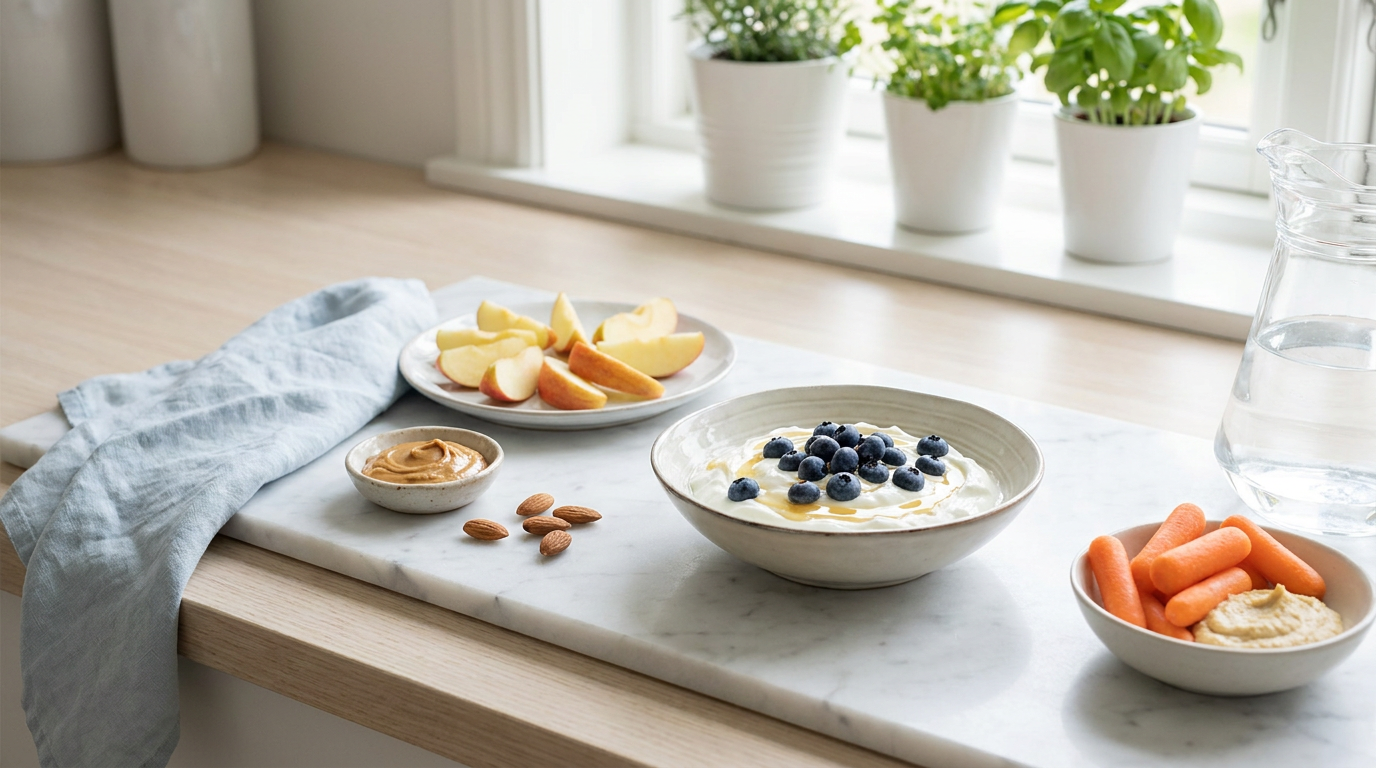
- Healthy snacks pair protein or fiber with a whole food and keep added sugar and sodium low. Greek yogurt with blueberries, apple with peanut butter, edamame, hard-boiled eggs and air-popped popcorn all fit [18, 21].
- Protein, fiber and volume may help a snack feel more filling, though the studies are small [3, 5]. Greek yogurt with blueberries has 17.9 g of protein for 142 calories, according to USDA data [18].
- Science hasn't settled how often to snack. The 2025 Dietary Guidelines Advisory Committee could not draw a conclusion on snacking and calorie intake in adults, so focus on what you snack on [2].
- On a GLP-1 medicine such as Wegovy® (semaglutide) or Zepbound® (tirzepatide), a 2025 joint nutrition advisory suggests regular small meals with protein-rich foods first [13]. A small snack built around protein can be one way to follow that advice.
Healthy snacks can carry you to your next meal, or they can quietly add up. Snacks supply 23% of the calories US adults eat each day, according to USDA's What We Eat in America survey for 2021 to 2023 [19].
Below are 30 healthy snacks to eat, each with USDA calories, protein and fiber, plus swaps, label tips and picks for work, bedtime and GLP-1 medicines.
What makes a snack healthy?
A healthy snack pairs protein or fiber with a whole food, keeps added sugar and sodium low, and is sized as a snack rather than a meal [21].
An FDA "healthy" claim on a snack package means the food meets limits on added sugar, sodium and saturated fat and has a set amount of a food group [6]. The FDA published the updated rule on December 27, 2024. Companies can use the new definition starting April 28, 2025, and must comply by February 25, 2028 [6, 10].
Under the FDA rule, nuts, seeds, eggs, olive oil and higher-fat fish such as salmon can now qualify as "healthy," while highly sweetened yogurt and cereal no longer do. The claim is voluntary, and the FDA has not finalized a "healthy" symbol [10]. The Dietary Guidelines name nuts, seeds, eggs and seafood as whole foods rich in healthy fats [21].
The Dietary Guidelines for Americans 2025 to 2030 say snacks should meet FDA "healthy" added-sugar limits, such as 5 g per 3/4 ounce whole-grain equivalent for grain snacks [21]. An "equivalent" is the standard serving size the guidelines use for each food group.
Under the Dietary Guidelines, a dairy snack such as yogurt should have no more than 2.5 g of added sugar per 2/3 cup equivalent [21]. The guidelines also say no amount of added sugar is recommended, and one meal should have no more than 10 g.
A healthy snack is not the same as a low-calorie snack. In USDA FoodData Central data, two small dill pickle spears have 8 calories but 566 mg of sodium, 25% of the Daily Value [7, 18]. An ounce of raw almonds has 164 calories, with 6.0 g of protein, 3.5 g of fiber and almost no sodium [18].
Protein-forward snacks
Protein-forward snacks on this list have 6.7 to 19.5 g of protein per serving, per USDA data [18]. Tuna with crackers and Greek yogurt with blueberries have the most, and Greek yogurt needs no prep. See our guide to high-protein foods for more options.
1. Greek yogurt with blueberries
Greek yogurt with blueberries (6 ounces plain nonfat yogurt, 1/2 cup berries) has 142 calories, 17.9 g of protein and 1.8 g of fiber, per USDA data [18]. Choose plain yogurt and let the fruit sweeten it, since the Dietary Guidelines cap added sugar in dairy snacks at 2.5 g per 2/3 cup equivalent [21].
2. Cottage cheese with pineapple
Cottage cheese with pineapple (1/2 cup 1% cottage cheese, 1/2 cup pineapple) has 123 calories, 14.4 g of protein and 1.2 g of fiber, per USDA data [18]. The pair has 460 mg of sodium, 20% of the Daily Value, almost all from the cottage cheese, so compare labels for a lower-sodium tub [7].
3. Hard-boiled eggs
Two large hard-boiled eggs have 155 calories, 12.6 g of protein and 0 g of fiber, per USDA data [18]. Under the FDA's updated rule, eggs can carry the "healthy" claim [10]. Boil a batch ahead and refrigerate the eggs within 2 hours of cooking [9].
4. Edamame
Edamame (1/2 cup shelled, cooked from frozen) has 94 calories, 9.2 g of protein and 4.0 g of fiber, per USDA data [18]. Its fiber is 14% of the 28 g Daily Value, so edamame brings protein and fiber in one food [7]. Dry-roasted edamame is a crunchy, shelf-stable version, so check its label for sodium.
5. String cheese
One part-skim mozzarella string cheese stick (1 ounce) has 84 calories, 6.7 g of protein and 0 g of fiber, per USDA data [18]. Pair it with a pear (#11) or whole-wheat crackers (#30) to add fiber, and keep it cold until you eat it.
6. Tuna with whole-wheat crackers
Tuna with whole-wheat crackers (3 ounces drained light tuna, 6 crackers) has 193 calories, 19.5 g of protein and 2.9 g of fiber, per USDA data [18]. Unopened cans and pouches need no fridge, but the pair has 434 mg of sodium, 19% of the Daily Value [7].
7. Deli turkey slices
Two ounces of sliced deli turkey breast (about 3.5 slices) have 60 calories, 8.4 g of protein and 0 g of fiber, per USDA data [18]. Deli turkey is high in sodium, with 509 mg or 22% of the Daily Value [7]. Look for a lower-sodium label, and roll the slices around bell pepper strips (#12).
Fiber-rich snacks
Fiber-rich snacks on this list carry 1.9 to 9.8 g of fiber per serving in USDA data, compared with a 28 g Daily Value [7, 18]. Most are fruit or vegetables, so pair them with a protein food to round them out.
8. Apple with peanut butter
An apple with peanut butter (1 medium apple, 2 tablespoons smooth peanut butter) has 286 calories, 7.6 g of protein and 6.0 g of fiber, per USDA [18]. It's the highest-calorie snack on this list, and 191 of those calories come from the peanut butter, so use less for a lighter snack.
9. Hummus with baby carrots
Hummus with baby carrots (1/4 cup of hummus plus 10 baby carrots) has 181 calories, 5.4 g of protein and 6.3 g of fiber, per USDA data [18]. That's 22% of the fiber Daily Value [7]. Hummus is made with tahini (sesame paste), so skip it if you're allergic to sesame.
10. Raspberries
One cup of raspberries has 64 calories, 1.5 g of protein and 8.0 g of fiber, per USDA data [18]. That's 29% of the fiber Daily Value, the most fiber of any fruit on this list [7].
11. Pear
One medium pear has 101 calories, 0.6 g of protein and 5.5 g of fiber, per USDA data [18]. Pears are low in protein, so pair one with string cheese (#5) or an ounce of almonds (#26).
12. Red bell pepper strips
One cup of sliced red bell pepper has 24 calories, 0.9 g of protein and 1.9 g of fiber, per USDA data [18]. It's the lowest-calorie snack on this list, so dip the strips in hummus or wrap them in deli turkey (#7) for protein.
13. Chia seeds
One ounce of dried chia seeds has 138 calories, 4.7 g of protein and 9.8 g of fiber, per USDA data [18]. That's 35% of the fiber Daily Value, the most fiber on this list [7]. Stir the seeds into yogurt or milk, and note these numbers are for the seeds alone.
Healthy sweet snacks
Healthy sweet snacks on this list run from 46 calories for a cup of strawberries to 201 for a banana with peanut butter, per USDA data [18]. Fruit does most of the sweetening, with one small portion of dark chocolate.
14. Frozen grapes
One cup of frozen grapes has 104 calories, 1.1 g of protein and 1.4 g of fiber, using USDA's fresh-grape values [18]. USDA's SR Legacy data has no separate frozen-grape entry, and the 23.4 g of sugar is naturally present in the fruit.
15. Dark chocolate with almonds
Dark chocolate with almonds (1/2 ounce of each, 70% to 85% cacao) has 167 calories, 4.1 g of protein and 3.3 g of fiber, per USDA data [18]. Both foods are energy dense, at 5.9 calories per gram together, so measure the ounce instead of eating from the bar.
16. Strawberries
One cup of whole strawberries has 46 calories, 1.0 g of protein and 2.9 g of fiber, per USDA data [18]. At 0.3 calories per gram, strawberries fill a bowl for few calories, so add Greek yogurt for protein.
17. Banana with peanut butter
A banana with peanut butter (1 medium banana, 1 tablespoon smooth peanut butter) has 201 calories, 4.8 g of protein and 3.9 g of fiber, per USDA [18]. Both travel without a fridge, which makes this an easy desk or gym-bag snack.
18. Dried apricots
A 1/4 cup of dried apricot halves has 78 calories, 1.1 g of protein and 2.4 g of fiber, per USDA data [18]. The Dietary Guidelines count frozen, dried or canned fruit as a good option when it has little or no added sugar, so check the label [21].
19. Clementines
Two clementines have 70 calories, 1.3 g of protein and 2.5 g of fiber, per USDA data [18]. The peel makes them an easy no-fridge snack.
Healthy salty and crunchy snacks
Healthy salty and crunchy snacks on this list swap fried chips for whole grains, beans, nuts, seeds and olives, at 51 to 219 calories in USDA data [18]. Unsalted versions keep sodium low.
20. Air-popped popcorn
Three cups of plain air-popped popcorn have 92 calories, 2.9 g of protein and 3.6 g of fiber, per USDA data [18]. Popcorn is a whole grain. Butter, oil and salt add calories and sodium that these unsalted numbers don't include.
21. Roasted chickpeas
Roasted chickpeas (1/2 cup of canned chickpeas, drained, rinsed and roasted without oil) have 105 calories, 5.4 g of protein and 4.8 g of fiber, per USDA data [18]. USDA's SR Legacy data has no roasted-chickpea entry, so these are canned-chickpea values. Store-bought versions with oil and seasoning will differ.
22. Pistachios
One ounce of dry-roasted, unsalted pistachios (about 49 kernels) has 162 calories, 6.0 g of protein and 2.9 g of fiber, per USDA data [18]. Counting out 49 kernels makes the portion easy to see, and salted versions add sodium.
23. Pumpkin seeds
One ounce of roasted, unsalted pumpkin seed kernels has 163 calories, 8.5 g of protein and 1.8 g of fiber, per USDA data [18]. That's the most protein of any nut or seed on this list.
24. Hummus with whole-wheat pita
Hummus with whole-wheat pita (1/4 cup hummus, one small 4-inch pita) has 219 calories, 7.5 g of protein and 5.1 g of fiber, per USDA data [18]. The pair has 380 mg of sodium, 17% of the Daily Value, so add vegetables rather than salty chips [7].
25. Olives
Ten large canned ripe olives have 51 calories, 0.4 g of protein and 0.7 g of fiber, per USDA data [18]. Olives satisfy a salty craving for few calories, but their 323 mg of sodium is 14% of the Daily Value [7].
Shelf-stable snacks for your desk or bag
Shelf-stable snacks need no fridge, so they're easy store-bought picks to keep at a desk, in a car or in a bag. The five here run from 116 to 185 calories per serving in USDA data [18].
26. Almonds
One ounce of raw almonds (about 23 nuts) has 164 calories, 6.0 g of protein and 3.5 g of fiber, per USDA data [18]. Raw almonds have almost no sodium, and an ounce fits in a small bag or desk jar.
27. Beef jerky
One ounce of beef jerky has 116 calories, 9.4 g of protein and 0.5 g of fiber, per USDA data [18]. USDA's entry is chopped-and-formed jerky with 506 mg of sodium, 22% of the Daily Value, and brands vary, so check the label [7].
28. Walnuts
One ounce of walnuts (about 14 halves) has 185 calories, 4.3 g of protein and 1.9 g of fiber, per USDA data [18]. Walnuts have the most calories per ounce of the nuts here, so measure the portion.
29. Raisins
One small box of raisins (1.5 ounces) has 129 calories, 1.4 g of protein and 1.9 g of fiber, per USDA data [18]. The box sets the portion, but its 28.0 g of natural sugar is the most on this list, so pair it with nuts.
30. Whole-wheat crackers
Six whole-wheat crackers have 120 calories, 3.0 g of protein and 2.9 g of fiber, per USDA data [18]. The Dietary Guidelines favor fiber-rich whole grains, so check that whole wheat comes first on the label [21]. Top the crackers with string cheese (#5) or tuna (#6).
All 30 healthy snacks at a glance
Of the 30 healthy snacks on this list, 26 need no cooking, just washing, cutting or portioning. Only the eggs, edamame, popcorn and roasted chickpeas need heat. The table below lists them in snack-group order, not by rank, with USDA FoodData Central values per serving [18].
| # | Snack | Serving | Calories | Protein (g) | Fiber (g) | Sodium (mg) | No cooking |
|---|---|---|---|---|---|---|---|
| 1 | Greek yogurt with blueberries | 6 oz plain nonfat Greek yogurt + 1/2 cup blueberries (244 g) | 142 | 17.9 | 1.8 | 62 | Yes |
| 2 | Cottage cheese with pineapple | 1/2 cup 1% cottage cheese + 1/2 cup pineapple chunks (195.5 g) | 123 | 14.4 | 1.2 | 460 | Yes |
| 3 | Hard-boiled eggs | 2 large (100 g) | 155 | 12.6 | 0 | 124 | No |
| 4 | Edamame | 1/2 cup shelled, cooked from frozen (77.5 g) | 94 | 9.2 | 4.0 | 5 | No |
| 5 | String cheese | 1 stick, 1 oz, part-skim mozzarella (28.35 g) | 84 | 6.7 | 0 | 189 | Yes |
| 6 | Tuna with whole-wheat crackers | 3 oz light tuna in water, drained + 6 crackers (113 g) | 193 | 19.5 | 2.9 | 434 | Yes |
| 7 | Deli turkey slices | 2 oz, about 3.5 slices (56.7 g) | 60 | 8.4 | 0 | 509 | Yes |
| 8 | Apple with peanut butter | 1 medium apple + 2 tbsp peanut butter (214 g) | 286 | 7.6 | 6.0 | 138 | Yes |
| 9 | Hummus with baby carrots | 1/4 cup hummus + 10 baby carrots (161.5 g) | 181 | 5.4 | 6.3 | 340 | Yes |
| 10 | Raspberries | 1 cup (123 g) | 64 | 1.5 | 8.0 | 1 | Yes |
| 11 | Pear | 1 medium (178 g) | 101 | 0.6 | 5.5 | 2 | Yes |
| 12 | Red bell pepper strips | 1 cup sliced (92 g) | 24 | 0.9 | 1.9 | 4 | Yes |
| 13 | Chia seeds | 1 oz, dried (28.35 g) | 138 | 4.7 | 9.8 | 5 | Yes |
| 14 | Frozen grapes | 1 cup (151 g) | 104 | 1.1 | 1.4 | 3 | Yes |
| 15 | Dark chocolate with almonds | 1/2 oz 70% to 85% dark chocolate + 1/2 oz almonds (28.35 g) | 167 | 4.1 | 3.3 | 3 | Yes |
| 16 | Strawberries | 1 cup whole (144 g) | 46 | 1.0 | 2.9 | 1 | Yes |
| 17 | Banana with peanut butter | 1 medium banana + 1 tbsp peanut butter (134 g) | 201 | 4.8 | 3.9 | 69 | Yes |
| 18 | Dried apricots | 1/4 cup halves (32.5 g) | 78 | 1.1 | 2.4 | 3 | Yes |
| 19 | Clementines | 2 clementines (148 g) | 70 | 1.3 | 2.5 | 1 | Yes |
| 20 | Air-popped popcorn | 3 cups, unsalted (24 g) | 92 | 2.9 | 3.6 | 1 | No |
| 21 | Roasted chickpeas | 1/2 cup canned, drained, rinsed, roasted without oil (76 g) | 105 | 5.4 | 4.8 | 161 | No |
| 22 | Pistachios | 1 oz, about 49 kernels, unsalted (28.35 g) | 162 | 6.0 | 2.9 | 2 | Yes |
| 23 | Pumpkin seeds | 1 oz kernels, unsalted (28.35 g) | 163 | 8.5 | 1.8 | 5 | Yes |
| 24 | Hummus with whole-wheat pita | 1/4 cup hummus + 1 small 4-inch whole-wheat pita (89.5 g) | 219 | 7.5 | 5.1 | 380 | Yes |
| 25 | Olives | 10 large ripe, canned (44 g) | 51 | 0.4 | 0.7 | 323 | Yes |
| 26 | Almonds | 1 oz, about 23 almonds, raw (28.35 g) | 164 | 6.0 | 3.5 | 0 | Yes |
| 27 | Beef jerky | 1 oz (28.35 g) | 116 | 9.4 | 0.5 | 506 | Yes |
| 28 | Walnuts | 1 oz, about 14 halves (28.35 g) | 185 | 4.3 | 1.9 | 1 | Yes |
| 29 | Raisins | 1 small box, 1.5 oz (43 g) | 129 | 1.4 | 1.9 | 11 | Yes |
| 30 | Whole-wheat crackers | 6 crackers (28 g) | 120 | 3.0 | 2.9 | 224 | Yes |
Table: Healthy snacks compared: calories, protein, fiber and sodium per serving. Source: USDA FoodData Central, SR Legacy (April 2018), per serving. Calories rounded to the nearest whole number, protein and fiber to 0.1 g, sodium to the nearest mg. Roasted chickpeas use canned chickpeas, drained and rinsed (no SR Legacy roasted-chickpea entry). Frozen grapes use fresh-grape values.
Good to know
Snacks for babies and young children follow different rules. The American Academy of Pediatrics advises keeping high-risk choking foods, such as nuts, whole grapes, popcorn and raw carrot sticks, from children until age 4 or older [1].
Healthy snacks for weight loss: which ones keep you full?
Snacks with more protein, fiber or water per calorie, such as Greek yogurt, edamame, raspberries and air-popped popcorn, may help you feel full [18]. In USDA data, they have 64 to 142 calories each. No snack causes weight loss on its own, and the 2013 protein-snack trials in Appetite and Nutrition Journal were small and mixed [3, 16].
| Snack (serving) | Calories | Protein (g) | Fiber (g) | Calories per gram |
|---|---|---|---|---|
| Greek yogurt with blueberries (6 oz plain nonfat Greek yogurt + 1/2 cup blueberries) | 142 | 17.9 | 1.8 | 0.6 |
| Cottage cheese with pineapple (1/2 cup 1% cottage cheese + 1/2 cup pineapple chunks) | 123 | 14.4 | 1.2 | 0.6 |
| Edamame (1/2 cup shelled, cooked from frozen) | 94 | 9.2 | 4.0 | 1.2 |
| Raspberries (1 cup) | 64 | 1.5 | 8.0 | 0.5 |
| Strawberries (1 cup whole) | 46 | 1.0 | 2.9 | 0.3 |
| Air-popped popcorn (3 cups, unsalted) | 92 | 2.9 | 3.6 | 3.8 |
| Almonds (1 oz, about 23 almonds, raw) | 164 | 6.0 | 3.5 | 5.8 |
Table: Fullness per calorie: protein, fiber and energy density of 7 snacks. Source: USDA FoodData Central, SR Legacy (April 2018).
In a 2013 trial, 32 healthy women ate a yogurt snack 3 hours after lunch on separate test days [16]. A 14 g protein Greek yogurt did no better on hunger or dinner intake than a 5 g regular yogurt. The study, published in Nutrition Journal, was funded by General Mills' Bell Institute.
In a smaller 2013 trial in the journal Appetite, 15 healthy women tested each yogurt snack for 3 days [3]. Any 160-calorie yogurt snack eased hunger compared with no snack, and a 24 g protein version kept hunger lower than a 5 g version.
Low calorie snacks that add volume may help too. In a 2007 trial lasting 1 year, 97 women with obesity added water-rich produce to a reduced-fat diet and ate more food by weight with less hunger [5]. See our list of high-volume, low-calorie foods.
Energy density (calories per gram) is only part of how filling a snack is. Air-popped popcorn has 3.8 calories per gram, yet 3 cups weigh only 24 g and have 92 calories in USDA data [18].
Nuts are energy dense, but they did not raise body weight in a 2021 Obesity Reviews analysis of 86 randomized trials with 5,873 people [14]. Several of the authors report nut-industry funding.
Candy and chips are low in protein, fiber and volume, so they may leave you hungrier sooner than Greek yogurt, edamame or air-popped popcorn. Small trials in Appetite and the American Journal of Clinical Nutrition link protein and water-rich produce with less hunger [3, 5]. If hunger feels constant even after meals, read about why you might always feel hungry.
How do you build a balanced snack?
Build a balanced, more filling snack in three steps: pick a protein food, add a fiber food, and keep the portion snack-sized. Small trials in Appetite and the American Journal of Clinical Nutrition suggest protein and water-rich produce may help you feel full [3, 5].
- Pick a protein food. Pair fruit with Greek yogurt (#1), cottage cheese (#2), peanut butter (#8, #17) or string cheese (#5); eggs, edamame, tuna and nuts also work. The Dietary Guidelines set a protein goal of 1.2 to 1.6 g per kilogram of body weight a day [21].
- Add a fiber food. Fruit, vegetables, whole grains, beans and seeds add fiber. The FDA Daily Value for fiber is 28 g, and the Dietary Guidelines don't set a separate fiber target [7, 21].
- Keep the portion snack-sized. No federal guideline sets a calorie number for a snack. Of the 30 snacks here, 27 have 200 calories or fewer, and the full range runs from 24 to 286 [18].
To prep snacks for the week, do the slow steps once and follow FDA safe food handling advice for anything perishable [9]:
- Boil a batch of eggs and refrigerate them within 2 hours [9].
- Wash and cut vegetables and fruit, then keep them in the fridge at 40°F or below [9].
- Portion nuts, seeds and popcorn into 1-ounce bags or cups.
- Rinse canned chickpeas and roast them without oil (#21).
Related reading High-protein meals: Build meals that keep you satisfied so you need fewer snacks. Is peanut butter good for you?: What a serving adds, and how to pick a jar. Edamame nutrition: Protein, fiber and easy ways to eat it.
Healthy swaps for sweet, salty and crunchy cravings
Instead of potato chips, try air-popped popcorn: per USDA data, an ounce has 108 calories and 4.3 g of fiber, compared with 151 and 0.9 g for chips [18]. Not every swap cuts calories, as the table shows.
| Usual snack | Swap | What changes per serving (usual vs swap) | Honest trade-off |
|---|---|---|---|
| Potato chips, plain, salted (1 oz) | Air-popped popcorn, unsalted (1 oz, about 3.5 cups) | Calories 151 vs 108. Fiber 0.9 g vs 4.3 g. Sodium 149 mg vs 1 mg. | Butter, oil and salt add calories and sodium back. Popcorn is also less energy dense than chips (3.8 vs 5.3 calories per gram), so the same calories fill a much bigger bowl. |
| Milk chocolate (1 oz) | Dark chocolate, 70% to 85% cacao (1 oz) | Calories 152 vs 170. Fiber 1.0 g vs 3.1 g. Total sugars 14.6 g vs 6.8 g. | Dark chocolate has 18 more calories and more saturated fat (5.2 g vs 6.9 g). The gain is fiber and less sugar. |
| Hard pretzels, salted (1 oz) | Roasted chickpeas (1/2 cup canned, rinsed, roasted without oil) | Calories 109 vs 105. Protein 2.8 g vs 5.4 g. Fiber 1.0 g vs 4.8 g. Sodium 352 mg vs 161 mg. | Chickpea values are canned chickpeas as a stand-in. Oil and seasoning on store-bought versions add calories and sodium. |
| Gummy candy (1 oz; USDA gumdrops entry) | Frozen grapes (1 cup) | Calories 112 vs 104. Fiber 0 g vs 1.4 g. Weight 28.35 g vs 151 g. | Grapes have more total sugar (23.4 g vs 16.7 g), but it is naturally present in the fruit, not added. |
| Vanilla ice cream (1/2 cup) | Plain nonfat Greek yogurt (6 oz) with 1/2 cup blueberries | Calories 137 vs 142. Protein 2.3 g vs 17.9 g. Saturated fat 4.5 g vs 0.2 g. | Calories and total sugars stay close (14.0 g vs 12.9 g). The gain is protein. |
| Hard granola bar, plain (1 oz) | Raw almonds (1 oz) | Calories 132 vs 164. Protein 2.8 g vs 6.0 g. Fiber 1.5 g vs 3.5 g. Total sugars 8.0 g vs 1.2 g. | Almonds have 32 more calories. They win on protein, fiber and sugar. |
Table: Healthy snack swaps: what changes per serving. Source: USDA FoodData Central, SR Legacy (April 2018). Sugars are total sugars, because USDA lists no added-sugars value for 70% to 85% dark chocolate.
Frozen grapes, strawberries, raspberries and Greek yogurt with blueberries are healthy sweet snacks that also bring fiber or protein, according to USDA FoodData Central [18].
Healthy crunchy snacks include air-popped popcorn, roasted chickpeas, nuts, seeds and raw vegetables such as bell pepper strips, celery, cucumber and baby carrots. Unsalted versions keep sodium in check.
Is snacking good or bad for you?
There's no clear evidence that snacking between meals is bad for you by itself. The 2025 Dietary Guidelines Advisory Committee could not tell whether snacking changes how many calories adults eat, so what you snack on is the part you can control [2].
The 2025 Dietary Guidelines Advisory Committee reviewed studies from 2000 to May 2023 [2]. It said "a conclusion statement cannot be drawn" about snacking and calorie intake in adults. The review measured calorie intake, not weight, so it can't say whether snacking slows weight loss.
Ultra-processed snacks (factory-made foods with many added ingredients) may matter more than how often you snack. In a small, tightly controlled 2019 NIH inpatient trial, 20 adults ate ultra-processed and unprocessed diets for 2 weeks each [11]. They ate 508 more calories a day and gained 0.9 kg on the ultra-processed diet, and lost 0.9 kg on the unprocessed one.
The Dietary Guidelines for Americans 2025 to 2030 advise avoiding highly processed salty or sweet foods such as chips, cookies and candy [21].
Snacks also shape what you eat overall. In USDA survey data for 2021 to 2023, snacks supply 38% of US adults' total sugars but only 13% of their protein [19].
Gummy fruit snacks aren't whole fruit, so check the added sugars line on the Nutrition Facts label before counting them as a healthy snack. Roasted seaweed snacks vary by brand, and USDA's standard reference data has no entry for them, so check the label for sodium.
How many snacks a day should you eat?
No set number of snacks a day is right for everyone, and snacking is optional. In USDA's What We Eat in America survey for 2021 to 2023, 96% of US adults had at least one snack [19]. In the same survey, 63% of adults had two to four snack occasions a day [20].
You don't need snacks if three meals keep you satisfied. USDA's count of snack occasions includes drinks, and water was the only item in about 29% of them [20]. If you're thirsty rather than hungry, a glass of water may be enough, and the Dietary Guidelines advise choosing water or unsweetened drinks [21].
No official guideline names a best time to have a snack. A snack makes sense when you're hungry and your next meal is a long way off.
A snack may help if:
- Your meals are far apart. A planned snack may keep you from arriving at dinner overly hungry.
- You're an older adult with a small appetite. The Dietary Guidelines say some older adults need fewer calories but the same or more protein [21].
- You take a GLP-1 medicine. The 2025 joint advisory suggests regular small meals, and a small protein-forward snack can be one way to follow that on low-appetite days [13].
- You have diabetes and take certain medicines. Ask your care team how snacks fit your medicine and schedule.
You may not need a snack if you aren't hungry or your next meal is soon. Eating out of habit or boredom adds calories you may not need.
Healthy snacks for work, travel and on the go
Healthy snacks for work that need no fridge include nuts, seeds, beef jerky, whole fruit, raisins, whole-wheat crackers and air-popped popcorn. Sort the 30 ideas by where you'll eat them:
- Desk drawer (no fridge): almonds (#26), pistachios (#22), walnuts (#28), pumpkin seeds (#23), beef jerky (#27), raisins (#29), whole-wheat crackers (#30) and air-popped popcorn (#20). Whole apples, pears, bananas and clementines keep at room temperature, and homemade trail mix of unsalted nuts, seeds and raisins works if you portion it ahead.
- Office fridge: Greek yogurt (#1), cottage cheese (#2), hard-boiled eggs (#3), edamame (#4), string cheese (#5) and hummus with carrots (#9).
- Car or travel bag: nuts, jerky, raisins, crackers, bananas, clementines, single-serve peanut butter packets and an unopened can or pouch of tuna (#6). Add an ice pack for anything perishable.
- Gas station or airport: look for plain nuts, beef jerky, bananas or other whole fruit, and string cheese or hard-boiled eggs from the cooler. Check the sodium on jerky.
Ranked by protein per serving in USDA data, the top no-fridge picks are [18]:
- Tuna with whole-wheat crackers (#6), with the can unopened
- Beef jerky (#27)
- Pumpkin seeds (#23)
- Apple with peanut butter (#8), using a single-serve packet
- Almonds (#26) and pistachios (#22), about tied
Perishable snacks such as yogurt, cheese and hard-boiled eggs belong back in the fridge within 2 hours, according to the FDA [9]. If it's above 90°F outside, the limit is 1 hour.
What are healthy late-night snacks?
Healthy late-night snacks are small, like strawberries, raspberries, string cheese, air-popped popcorn, cottage cheese with pineapple or Greek yogurt with berries, each under 150 calories in USDA data [18]. A small snack before bed can fit a healthy diet, but research on late eating is limited to small studies, such as a 2022 inpatient trial [22].
In a 2022 inpatient trial, 16 adults with overweight or obesity ate the same meals earlier or later in the day for 6 days each [22]. Eating later doubled their odds of feeling hungry. Late eating also lowered calories burned while awake. Participants' weight was kept stable on purpose, so the study can’t show whether late eating causes weight gain.
For a late-night snack while you're trying to lose weight, these six picks from the list are ranked from fewest calories, using USDA FoodData Central values [18]:
- Strawberries (#16): 46 calories
- Raspberries (#10): 64 calories
- String cheese (#5): 84 calories
- Air-popped popcorn (#20): 92 calories
- Cottage cheese with pineapple (#2): 123 calories
- Greek yogurt with blueberries (#1): 142 calories
None of the studies reviewed for this article tested whether a snack improves sleep.
No official guideline sets a cutoff for eating before bed. If a late snack keeps you up or feels uncomfortable, have it earlier or make it smaller.
How do you pick healthy store-bought snacks?
To pick a healthy store-bought snack, check four things on the Nutrition Facts label: serving size, added sugars, sodium, and protein plus fiber. The FDA says 5% Daily Value or less per serving is low, and 20% or more is high [8].
- Serving size: The FDA says serving size reflects what people typically eat, not what you should eat [8]. If you eat two servings, double every number.
- Added sugars: Look for a low %DV. For added sugars, 20% DV is 10 g, based on the 50 g Daily Value [7].
- Sodium: For sodium, 20% DV is 460 mg, based on the 2,300 mg Daily Value [7].
- Protein and fiber: More of each may help a snack feel filling [3, 5]. A snack with 20% DV for fiber has at least 5.6 g [7].
The FDA gives companies until February 25, 2028, to comply with its updated "healthy" rule [6]. Read the Nutrition Facts label rather than relying on a front-of-box claim.
| Trap (problem) | Why it can mislead (cause) | Fix |
|---|---|---|
| Granola bars | A plain hard granola bar (1 oz) has 132 calories, 2.8 g of protein, 1.5 g of fiber and 8.0 g of total sugars in USDA data. | Read the added sugars line. For more protein and fiber, try 1 oz of almonds (#26). |
| Fruit snacks | A fruit name or picture on the box doesn't make a gummy snack a serving of fruit. | Check the added sugars line, or choose whole fruit (#10, #11, #14, #16, #19). |
| Veggie straws and veggie chips | A vegetable name doesn't promise vegetable-level fiber. | Check fiber and sodium %DV, or snack on bell pepper strips (#12) or baby carrots (#9). |
| Yogurt-covered snacks | A yogurt coating isn't the same food as a cup of plain yogurt. | Check the added sugars line, or choose plain Greek yogurt with fruit (#1). |
| Rice cakes | Two plain brown rice cakes have 70 calories but only 1.5 g of protein and 0.8 g of fiber. | Top them with peanut butter or cottage cheese for protein. |
Table: Health-halo traps: problem, cause and fix. Food values: USDA FoodData Central, SR Legacy (April 2018).
Healthier snacks can cost more, but it depends on the food. In a 2013 BMJ Open meta-analysis of 27 studies from 10 countries, healthier options cost more than less healthy ones in most food groups [17]. The gap per serving was smaller for snacks and sweets than for meats and other protein foods.
Healthy snacks don't have to be packaged snack products, and many on this list are everyday staples. Examples include eggs, bananas, carrots, canned tuna, canned chickpeas and plain popcorn kernels. Prices vary by store, so compare unit prices on the shelf tag.
For heart health, check sodium and saturated fat on the label. The Dietary Guidelines keep sodium under 2,300 mg a day and saturated fat at no more than 10% of calories [21]. For snacks that fit a blood sugar plan, see our guide to eating with type 2 diabetes.
What should you snack on while taking a GLP-1 medicine?
On a GLP-1 medicine such as Wegovy® (semaglutide) or Zepbound® (tirzepatide), a 2025 joint advisory from four medical and nutrition societies suggests regular small meals and enough protein [13]. A small snack built around protein, such as tuna with crackers, Greek yogurt, cottage cheese or hard-boiled eggs, can be one way to follow that advice.
GLP-1 is a natural hormone that helps regulate appetite and how much you eat [15]. Wegovy® acts on its receptor, and Zepbound® acts on both the GLP-1 and GIP receptors [4, 15]. Learn more about GLP-1 medicines for weight loss.
Wegovy® and Zepbound® commonly cause nausea. In Wegovy®'s prescribing information (June 2026), 44% of adults in the main weekly-injection weight-loss trials, lasting up to 68 weeks, had nausea, versus 16% on placebo [15]. In Zepbound®'s prescribing information (August 2026), 25% to 29% had nausea in weight-loss trials lasting up to 72 weeks, versus 8% on placebo [4].
When GLP-1 nausea hits, the 2025 joint advisory suggests small meals every 3 to 4 hours with enough fluids [13]. The advisory also suggests avoiding fatty or high-fiber foods in the first few days of treatment.
Low-fat picks on this list include plain nonfat Greek yogurt (#1) and 1% low-fat cottage cheese (#2). See our tips for easing GLP-1 nausea.
Neither the Wegovy® nor the Zepbound® prescribing information advises smaller meals, but both Medication Guides say to drink fluids, since nausea, vomiting and diarrhea can cause dehydration [4, 15]. Wegovy® comes as an injection and as a tablet [15].
To get enough protein when you're not hungry, the 2025 joint advisory suggests eating protein-rich foods first [13]. The advisory notes that 1.2 to 1.6 g per kilogram a day has been proposed during weight loss. As a simpler alternative, it suggests a fixed target of 80 to 120g a day. For someone who weighs 80 kg (about 176 lb), that's 96 to 128 g a day.
The 2025 joint advisory notes that using actual body weight can overestimate needs for people with obesity, so ask your care team for your target [13]. Here are the six protein-forward picks from this list (#1 to #6), sorted by protein per serving in USDA data [18]:
- Tuna with whole-wheat crackers (#6): 19.5 g
- Greek yogurt with blueberries (#1): 17.9 g
- Cottage cheese with pineapple (#2): 14.4 g
- Hard-boiled eggs (#3): 12.6 g
- Edamame (#4): 9.2 g
- String cheese (#5): 6.7 g
If a GLP-1 medicine dulls your appetite, the 2025 joint advisory suggests avoiding long gaps between meals that leave you overly hungry [13]. The advisory also suggests limiting nighttime eating, sweets and savory snacks. A small protein-forward snack may be one way to avoid a long gap on low-appetite days.
Your prescriber sets and adjusts your dose. For a full eating plan, see our GLP-1 diet plan.
When to see a healthcare provider
See a healthcare provider if a snack causes allergy symptoms, if hunger feels constant even after meals, or if a GLP-1 medicine makes eating hard. Some people are allergic to foods on this list, such as peanuts, tree nuts, milk, eggs, fish, soy, wheat or sesame.
Call 911 or your local emergency number right away for signs of a severe allergic reaction (anaphylaxis) after eating [12]. Signs include trouble breathing or swallowing, wheezing, hives, a swollen face, eyes or tongue, slurred speech, dizziness or passing out [12].
Make an appointment if:
- You can't keep food or fluids down while taking a GLP-1 medicine.
- You have diabetes and snacks seem to affect your blood sugar.
- You feel hungry all the time, even after full meals.
Bottom line
- A healthy snack pairs protein or fiber with a whole food, keeps added sugar and sodium low, and is sized as a snack.
- All 30 healthy snacks here come with USDA calories, protein and fiber, from 24 to 286 calories per serving.
- Some swaps cut calories, like popcorn for chips. Others, like dark chocolate for milk chocolate, trade calories for more fiber and less sugar.
- How often to snack is unsettled science. On a GLP-1 medicine, small protein-forward snacks may help you meet protein needs.
Frequently asked questions
What are the top 10 healthiest snacks?
No official top-10 list of healthiest snacks exists. By protein plus fiber per 100 calories in USDA data, the first five are raspberries, edamame, deli turkey slices, Greek yogurt with blueberries and cottage cheese with pineapple [18]. Next come red bell pepper strips, tuna with whole-wheat crackers, chia seeds, roasted chickpeas and beef jerky, though deli turkey and jerky are high in sodium.
What is the healthiest thing to snack on?
No single snack is the healthiest, but good picks pair protein or fiber with a whole food. In USDA FoodData Central data, Greek yogurt with blueberries has 142 calories and 17.9 g of protein, and an apple with peanut butter has 6.0 g of fiber [18]. The Dietary Guidelines advise choosing nutrient-dense foods over highly processed salty or sweet snacks [21].
Is a 100-calorie snack enough to stop hunger?
A 100-calorie snack may ease hunger if it brings protein, fiber or volume, though no study reviewed here tested 100-calorie snacks directly. In a 2013 trial of 15 healthy women in the journal Appetite, any 160-calorie yogurt snack eased hunger compared with no snack [3]. Volume may help too: 3 cups of air-popped popcorn have 92 calories in USDA data [18].
Is dark chocolate a healthy snack?
Dark chocolate can be a healthy sweet snack in a 1-ounce portion. Per ounce in USDA data, 70% to 85% dark chocolate has 3.1 g of fiber and 6.8 g of sugar, while milk chocolate has 1.0 g and 14.6 g [18]. Dark chocolate also has more calories (170 vs 152) and more saturated fat (6.9 g vs 5.2 g).
How long can yogurt sit out in my bag?
Yogurt should go back in the fridge within 2 hours, according to FDA food safety advice for perishable foods [9]. If it's above 90°F outside, the limit drops to 1 hour. An ice pack in an insulated bag helps keep yogurt, cheese and hard-boiled eggs cold until you eat them.
Are granola bars healthy?
Granola bars vary by brand, and a plain hard granola bar is low in protein and fiber. One 1-ounce bar has 132 calories, 2.8 g of protein, 1.5 g of fiber and 8.0 g of total sugars in USDA data [18]. Check the added sugars line: 10 g or more is 20% of the Daily Value, which the FDA counts as high [7, 8].
Sources
- 1. American Academy of Pediatrics. (2026, February 27). Choking prevention. HealthyChildren.org. Retrieved October 1, 2026, from https://www.healthychildren.org/English/health-issues/injuries-emergencies/Pages/Choking-Prevention.aspx
- 2. Andres, A., Giovannucci, E., Fisher, J. O., Palacios, C., Raynor, H. A., Stanford, F. C., Anderson, C. A. M., Gardner, C. D., Hoelscher, D. M., Jernigan, V. B. B., Odoms-Young, A., Callahan, E. H., Cole, N. C., Higgins, M., Butera, G., Terry, N., & Obbagy, J. (2024). Frequency of meals and/or snacking and energy intake: A systematic review. USDA Nutrition Evidence Systematic Review. https://doi.org/10.52570/NESR.DGAC2025.SR10
- 3. Douglas, S. M., Ortinau, L. C., Hoertel, H. A., & Leidy, H. J. (2013). Low, moderate, or high protein yogurt snacks on appetite control and subsequent eating in healthy women. Appetite, 60(1), 117-122. https://doi.org/10.1016/j.appet.2012.09.012
- 4. Eli Lilly and Company. (2026). ZEPBOUND (tirzepatide) injection: Prescribing information (Revised 08/2026). Retrieved October 1, 2026, from https://pi.lilly.com/us/zepbound-uspi.pdf
- 5. Ello-Martin, J. A., Roe, L. S., Ledikwe, J. H., Beach, A. M., & Rolls, B. J. (2007). Dietary energy density in the treatment of obesity: A year-long trial comparing 2 weight-loss diets. American Journal of Clinical Nutrition, 85(6), 1465-1477. https://doi.org/10.1093/ajcn/85.6.1465
- 6. Food and Drug Administration. (2024). Food labeling: Nutrient content claims; definition of term "healthy." Federal Register, 89, 106064. https://www.federalregister.gov/documents/2024/12/27/2024-29957
- 7. Food and Drug Administration. (2024, March 5). Daily Value on the Nutrition and Supplement Facts labels. Retrieved October 1, 2026, from https://www.fda.gov/food/nutrition-facts-label/daily-value-nutrition-and-supplement-facts-labels
- 8. Food and Drug Administration. (2024, March 5). How to understand and use the Nutrition Facts label. Retrieved October 1, 2026, from https://www.fda.gov/food/nutrition-facts-label/how-understand-and-use-nutrition-facts-label
- 9. Food and Drug Administration. (2024, March 5). Safe food handling. Retrieved October 1, 2026, from https://www.fda.gov/food/buy-store-serve-safe-food/safe-food-handling
- 10. Food and Drug Administration. (2025, February 24). A fresh take on what "healthy" means on food packages. Retrieved October 1, 2026, from https://www.fda.gov/consumers/consumer-updates/fresh-take-what-healthy-means-food-packages
- 11. Hall, K. D., Ayuketah, A., Brychta, R., Cai, H., Cassimatis, T., Chen, K. Y., Chung, S. T., Costa, E., Courville, A., Darcey, V., Fletcher, L. A., Forde, C. G., Gharib, A. M., Guo, J., Howard, R., Joseph, P. V., McGehee, S., Ouwerkerk, R., Raisinger, K., ... Zhou, M. (2019). Ultra-processed diets cause excess calorie intake and weight gain: An inpatient randomized controlled trial of ad libitum food intake. Cell Metabolism, 30(1), 67-77.e3. https://doi.org/10.1016/j.cmet.2019.05.008
- 12. MedlinePlus. (2026, January 20). Anaphylaxis. National Library of Medicine. Retrieved October 1, 2026, from https://medlineplus.gov/ency/article/000844.htm
- 13. Mozaffarian, D., Agarwal, M., Aggarwal, M., Alexander, L., Apovian, C. M., Bindlish, S., Bonnet, J., Butsch, W. S., Christensen, S., Gianos, E., Gulati, M., Gupta, A., Horn, D., Kane, R. M., Saluja, J., Sannidhi, D., Stanford, F. C., & Callahan, E. A. (2025). Nutritional priorities to support GLP-1 therapy for obesity: A joint advisory from the American College of Lifestyle Medicine, the American Society for Nutrition, the Obesity Medicine Association, and The Obesity Society. American Journal of Clinical Nutrition, 122(1), 344-367. https://doi.org/10.1016/j.ajcnut.2025.04.023
- 14. Nishi, S. K., Viguiliouk, E., Blanco Mejia, S., Kendall, C. W. C., Bazinet, R. P., Hanley, A. J., Comelli, E. M., Salas Salvadó, J., Jenkins, D. J. A., & Sievenpiper, J. L. (2021). Are fatty nuts a weighty concern? A systematic review and meta-analysis and dose-response meta-regression of prospective cohorts and randomized controlled trials. Obesity Reviews, 22(11), e13330. https://doi.org/10.1111/obr.13330
- 15. Novo Nordisk. (2026). WEGOVY (semaglutide) injection; WEGOVY (semaglutide) tablets: Prescribing information (Revised 06/2026). Retrieved October 1, 2026, from https://www.novo-pi.com/wegovy.pdf
- 16. Ortinau, L. C., Culp, J. M., Hoertel, H. A., Douglas, S. M., & Leidy, H. J. (2013). The effects of increased dietary protein yogurt snack in the afternoon on appetite control and eating initiation in healthy women. Nutrition Journal, 12, 71. https://doi.org/10.1186/1475-2891-12-71
- 17. Rao, M., Afshin, A., Singh, G., & Mozaffarian, D. (2013). Do healthier foods and diet patterns cost more than less healthy options? A systematic review and meta-analysis. BMJ Open, 3(12), e004277. https://doi.org/10.1136/bmjopen-2013-004277
- 18. U.S. Department of Agriculture, Agricultural Research Service. (2018). FoodData Central: SR Legacy (April 2018). Retrieved October 1, 2026, from https://fdc.nal.usda.gov/
- 19. U.S. Department of Agriculture, Agricultural Research Service. (2024). Table 25. Snacks: Percentages of selected nutrients contributed by food and beverages consumed at snack occasions, by male/female and age. What We Eat in America, NHANES August 2021-August 2023. Retrieved October 1, 2026, from https://www.ars.usda.gov/ARSUserFiles/80400530/pdf/2123/Table_25_SNK_MaleFemale_2123.pdf
- 20. U.S. Department of Agriculture, Agricultural Research Service. (2024). Table 29. Snacks: Distribution of snack occasions, by male/female and age. What We Eat in America, NHANES August 2021-August 2023. Retrieved October 1, 2026, from https://www.ars.usda.gov/ARSUserFiles/80400530/pdf/2123/Table_29_DSO_MaleFemale_2123.pdf
- 21. U.S. Department of Health and Human Services & U.S. Department of Agriculture. (2026). Dietary guidelines for Americans, 2025-2030. Retrieved October 1, 2026, from https://cdn.realfood.gov/DGA_508.pdf
- 22. Vujović, N., Piron, M. J., Qian, J., Chellappa, S. L., Nedeltcheva, A., Barr, D., Heng, S. W., Kerlin, K., Srivastav, S., Wang, W., Shoji, B., Garaulet, M., Brady, M. J., & Scheer, F. A. J. L. (2022). Late isocaloric eating increases hunger, decreases energy expenditure, and modifies metabolic pathways in adults with overweight and obesity. Cell Metabolism, 34(10), 1486-1498.e7. https://doi.org/10.1016/j.cmet.2022.09.007


Comments