
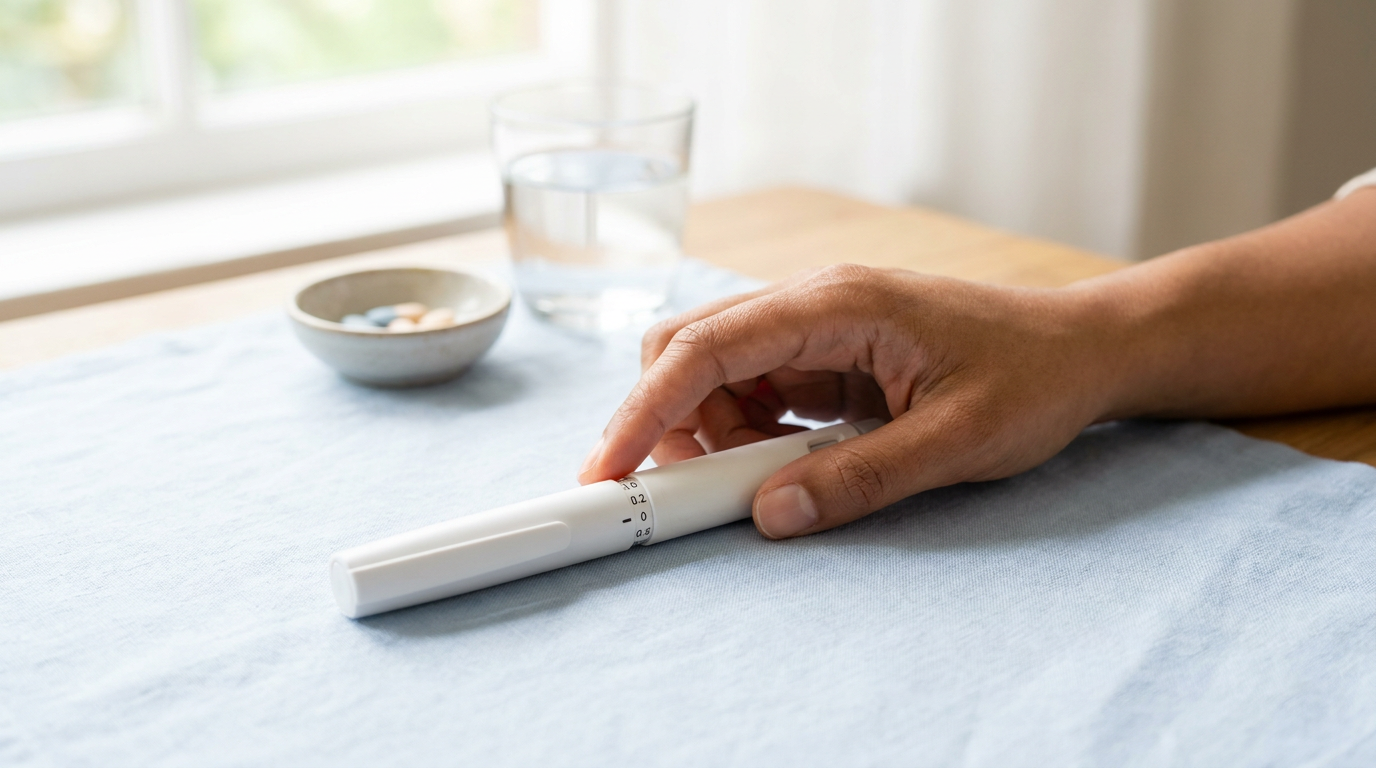
Saxenda® and Victoza® dosage numbers can look alike at first glance. You may see the same milligrams and wonder if the two brands are the same.
Maybe your first week felt like a tiny dose, and you wondered if it was doing anything. Maybe a small step up made your stomach turn.
That worry is common, and it is worth understanding. The good news is that both schedules are written down in plain terms.
Key takeaways
- Saxenda® and Victoza® both use liraglutide, but their FDA-labeled dose schedules are not the same.
- Saxenda® is for weight management and steps up weekly from 0.6 mg to 3.0 mg.
- Victoza® is for type 2 diabetes and rises from 0.6 mg to a 1.8 mg maximum.
- Both are taken once every day, unlike weekly semaglutide or tirzepatide brands.
- The label shows the schedule, but your care team sets the dose that fits you.
What this guide answers
- How does the Saxenda® dose schedule climb, and where does it stop?
- How is the Victoza® dose schedule different from Saxenda®?
- Why are both taken daily when other GLP-1 brands are weekly?
- What results did Saxenda® show in its main trial?
- What should you ask before any dose change?
Saxenda® and Victoza® dosage schedules side by side
Here is the simple picture. Both brands start at the same first dose, then take different paths.
| Week | Saxenda® (weight management) | Victoza® (type 2 diabetes) |
|---|---|---|
| Week 1 | 0.6 mg once daily | 0.6 mg once daily (start dose, not for blood sugar control) |
| Week 2 | 1.2 mg once daily | 1.2 mg once daily |
| Week 3 | 1.8 mg once daily | May increase to 1.8 mg once daily, after at least 1 week |
| Week 4 | 2.4 mg once daily | Stays at 1.8 mg once daily (maximum) |
| Week 5 and on | 3.0 mg once daily (maintenance) | Stays at 1.8 mg once daily (maximum) |
FDA-labeled titration for Saxenda® and Victoza®. Your care team may adjust the pace.
Who Saxenda® and Victoza® are each for
The two brands share one medicine but aim at different goals. That is why the doses stop at different points.
Saxenda® is approved for chronic weight management. It is for adults with obesity, or adults who are overweight and have at least one weight-related condition. It is also approved for some children aged 12 and older.
Victoza® is approved to improve blood sugar in type 2 diabetes. It is for adults and some children aged 10 and older. In adults with heart disease, it is also approved to lower the risk of major heart events.
How the Saxenda® dose schedule climbs to 3.0 mg
Saxenda® is the liraglutide brand for chronic weight management. It uses a slow, steady step-up.
The FDA label starts you at 0.6 mg once a day in week one. That first dose is small on purpose, to help your body adjust.
Here is how Saxenda® steps up week by week, per the FDA label:
1. Week 1: 0.6 mg once daily, to help your body adjust.
2. Week 2: 1.2 mg once daily.
3. Week 3: 1.8 mg once daily.
4. Week 4: 2.4 mg once daily.
5. Week 5 and beyond: 3.0 mg once daily, the maintenance dose.
Week five is the top of the ladder for Saxenda®. Most people stay at 3.0 mg once daily from there.
Saxenda® climbs from 0.6 mg to 3.0 mg once daily, one small weekly step at a time.
How the Victoza® dose schedule is different
Victoza® is the liraglutide brand for type 2 diabetes in adults and some children. Its schedule is shorter.
The FDA label also starts at 0.6 mg once a day. This first dose helps your body adjust, and it is not meant to control blood sugar.
After one week, the dose moves to 1.2 mg once daily. Your care team may raise it to 1.8 mg once daily, the maximum, after at least another week.
So Victoza® tops out at 1.8 mg once daily. Saxenda® keeps climbing to 3.0 mg because the two brands are approved for different goals.
Why Saxenda® and Victoza® are taken every day
Both brands use liraglutide, and liraglutide is a once-daily medicine. That is the key difference from some other GLP-1 brands.
Semaglutide brands like Wegovy® and Ozempic® are taken once a week. Tirzepatide brands like Zepbound® and Mounjaro® are also once weekly.
So if you switch from a weekly brand, the daily rhythm can feel new. A set daily time can make it easier to remember.
Saxenda® and Victoza® are daily shots, while Wegovy®, Ozempic®, Zepbound® and Mounjaro® are weekly.
What Saxenda® showed in the SCALE trial
Dose schedules make more sense when you see what the top dose can do. Saxenda® was studied in a large trial called SCALE.
In the SCALE Obesity and Prediabetes trial, 3,731 adults took part over 56 weeks. About 2,487 used Saxenda® and 1,244 used a placebo.
Adults on Saxenda® lost about 7.4% of their body weight on average. Adults on placebo lost about 3.0%. The difference was about 4.5%.
These SCALE results apply only to the FDA-approved branded product. They do not transfer to compounded preparations.
Compounded liraglutide is not FDA-approved, is not a generic of Saxenda® or Victoza®, and is not evaluated by the FDA for safety, effectiveness, or quality.
In SCALE, adults on Saxenda® lost about 7.4% of body weight over 56 weeks, versus about 3.0% on placebo.
Side effects to know on Saxenda® and Victoza®
Both brands can upset your stomach, especially as the dose goes up. Most effects are mild and often ease over time.
On Saxenda®, common effects include nausea, diarrhea, constipation, and vomiting. Some people also notice headache, low blood sugar, or feeling tired.
On Victoza®, nausea was reported by about 20% of people. Diarrhea affected about 12%, and vomiting about 9%.
Low blood sugar is more likely if you also take insulin or a sulfonylurea. Your care team can plan for that.
What to ask before a Saxenda® or Victoza® dose change
A dose change is a normal part of both schedules. It helps to go in with a few questions ready.
3. Pi-Sunyer X, et al. A randomized, controlled trial of 3.0 mg of liraglutide in weight management (SCALE). N Engl J Med. 2015;373:11-22. PMID 26132939. NCT01272219.
Frequently asked questions
Which dose am I on now, and what is the next step?
How long should I stay at each dose before moving up?
What should I do if nausea or stomach upset gets strong?
Are any of my other medicines affected, like insulin or a sulfonylurea?
What is my target dose, and when might I reach it?
The labels give the map, but your plan is personal. Your care team fits the schedule to your body and your goals.
Are Saxenda® and Victoza® the same medicine?
Saxenda® and Victoza® both use liraglutide, so the active medicine is the same. The difference is the job each one does. Saxenda® is approved for chronic weight management. Victoza® is approved for blood sugar control in type 2 diabetes. Because the goals differ, the FDA-labeled dose schedules differ too.
What is the maximum dose of Saxenda® and Victoza®?
The FDA label sets a maintenance dose of 3.0 mg once daily for Saxenda®. That is the top step for weight management. Victoza® has a lower ceiling for type 2 diabetes. Its maximum is 1.8 mg once daily. Both brands reach these doses by stepping up slowly, week by week, rather than starting high.
Are Saxenda® and Victoza® daily or weekly shots?
Both are once-daily shots, because liraglutide is a daily medicine. Many newer GLP-1 brands are weekly instead. Semaglutide brands like Wegovy® and Ozempic® are taken once a week. Tirzepatide brands like Zepbound® and Mounjaro® are also weekly. If you are used to a weekly brand, a daily routine can take a little time to settle in.
Why do both brands start at 0.6 mg?
The 0.6 mg starting dose is not meant to do the main job yet. It gives your body time to get used to liraglutide. That gentle start can lower the chance of strong nausea. For Victoza®, the label is clear that 0.6 mg is a start dose and not for blood sugar control. The dose then steps up on schedule.
How much weight did people lose with Saxenda® in trials?
In the SCALE Obesity and Prediabetes trial, 3,731 adults were studied over 56 weeks. Adults on Saxenda® lost about 7.4% of their body weight on average. Adults on placebo lost about 3.0%. That is a difference of about 4.5%. These results are for the FDA-approved brand and do not transfer to compounded preparations.
Can I change my Saxenda® or Victoza® dose on my own?
It is best not to change your dose on your own. The FDA schedules are a guide, and your care team tailors the plan to you. They may slow the step-up if your stomach is upset. They may hold a dose longer than the label example. Bring your questions to each visit so the plan fits your needs.
What are the most common side effects?
Stomach effects are the most common on both brands. On Saxenda®, these include nausea, diarrhea, constipation, and vomiting. On Victoza®, nausea was reported by about 20% of people, with diarrhea and vomiting next. Low blood sugar is more likely if you also use insulin or a sulfonylurea. Most effects are mild and often ease as your body adjusts.
Keep reading
Saxenda® & Victoza®: the liraglutide brands explained
See how both liraglutide brands compare in one place, from uses to what to expect.
Read more →Important: This page is for education only and is not medical advice. Any medicines named here are available by prescription. Always talk to a licensed clinician about medicines, symptoms, or anything you are considering.
Related data
- When generic liraglutide arrives →FDA patent and exclusivity expiry dates
- Liraglutide clinical trials →Registered studies, phases and status
- FDA drug shortage tracker →Which peptide drugs are in shortage now, with the FDA-stated cause
- Which peptides are FDA-approved →Approval status for every peptide, from Drugs@FDA



Comments