
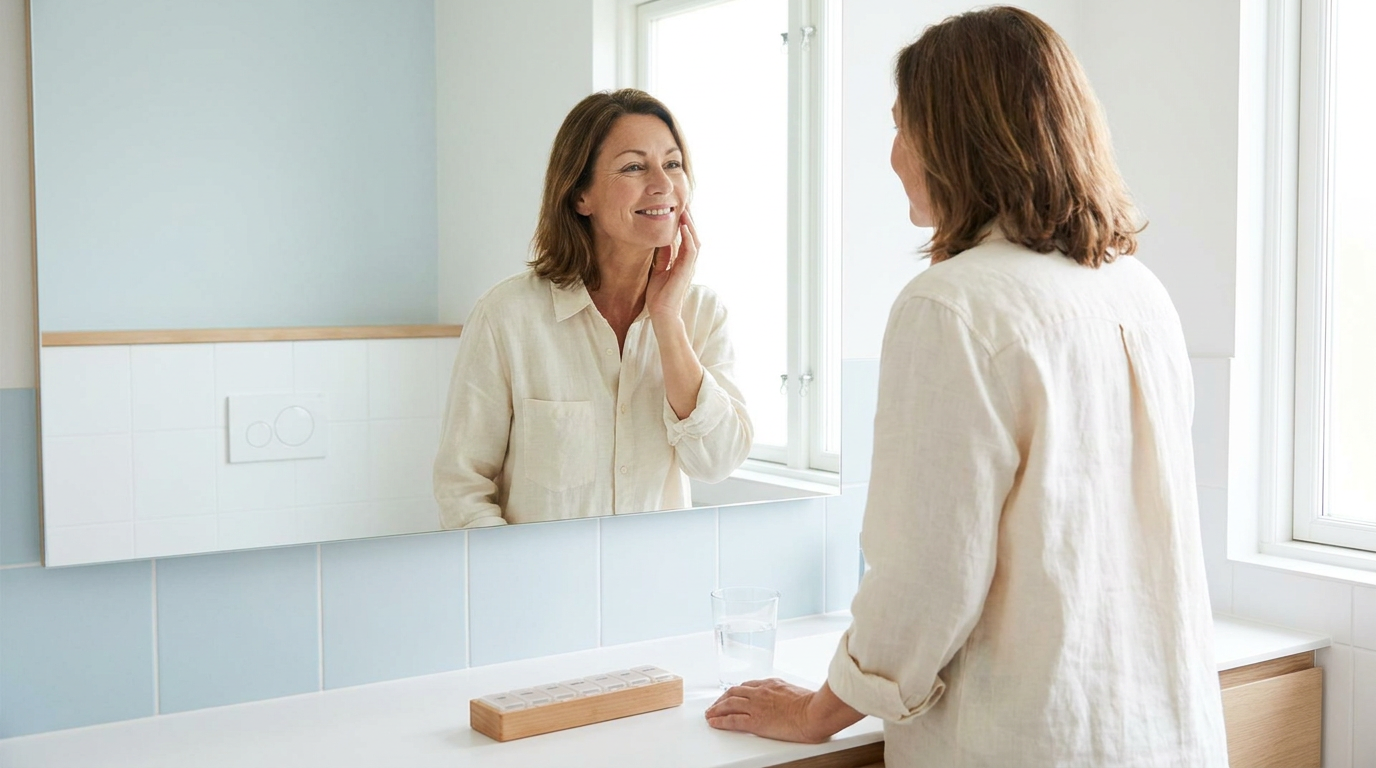
- "Ozempic® face" is a popular name for the hollow, older look some people get after losing a lot of weight on drugs like Ozempic® (semaglutide). It comes mainly from losing facial fat, not from a direct drug effect.
- In a 2025 imaging study of 20 adults on GLP-1 drugs, the midface lost about 7% of its volume for every 10 kg (22 lb) of body weight lost, mostly from fat just under the skin [16].
- No method is proven to prevent Ozempic® face. Enough protein, strength training, daily sunscreen and not smoking protect muscle and skin, but none was tested against facial volume loss.
- Ozempic® face usually doesn't improve on its own while weight stays off. Fillers, collagen-stimulating injections and fat grafting can restore volume, and a lower facelift treats loose skin once weight is stable [3].
People who lose a lot of weight on Ozempic® (semaglutide), Wegovy® (semaglutide), Mounjaro® (tirzepatide) or Zepbound® (tirzepatide) sometimes notice that their face looks thinner, hollower or older. This is what people call "Ozempic® face." It can show up even when you feel healthier than you have in years.
The good news is that researchers have now measured it, and there are real options if it bothers you. Read on to learn why it happens, who is more likely to get it, what may lower your risk and which treatments help.
What is Ozempic® face?
Ozempic® face is a nonmedical name for the loss of facial fullness, sagging skin and older look that can follow major weight loss on a GLP-1 drug. It is not a diagnosis, and it isn't limited to Ozempic®. People also call it "Wegovy® face" or "Mounjaro® face."
GLP-1 drugs (glucagon-like peptide-1 receptor agonists) lower appetite, so people eat less and lose weight. Learn more in our weight loss guide. Plastic surgeons now use "Ozempic® face" in research papers to describe facial volume loss that looks like faster aging [3].
Ozempic® is FDA-approved for type 2 diabetes, not for weight loss [12]. Wegovy®, which contains the same drug, is approved for weight loss as a weekly injection and a daily tablet [13]. Mounjaro® is approved for type 2 diabetes, and Zepbound®, which contains the same drug, is approved for weight loss [4, 5].
Common signs include:
- Hollow cheeks and temples: The fat pads that give cheeks their round shape get smaller [3, 16].
- Hollows under the eyes: The tear trough area under the lower lid can look deeper [3].
- Deeper folds: The lines from the nose to the corners of the mouth (nasolabial folds) can look more marked [3].
- Loose skin along the jaw and neck: Skin that stretched over a fuller face may not shrink back fully, so it can sag into jowls [3].
- A longer, older-looking face: The overall effect can make a face look older than its age [3].
Is Ozempic® face a side effect of the drug?
Ozempic® face is best explained as an effect of losing weight, not as a direct drug side effect. The amount of facial volume lost tracks the amount of body weight lost [16]. None of the current Ozempic®, Wegovy®, Mounjaro® or Zepbound® labels lists facial volume loss or skin aging as a side effect [4, 5, 12, 13].
Some researchers think GLP-1 drugs may add other effects on top of weight loss. A 2024 review proposed that the drugs may also affect fat in the deeper skin layers and the stem cells inside facial fat [14]. That idea comes from lab and mechanism research, and it has not been proven in people.
FDA's adverse event reporting system (FAERS) shows how rarely people report facial changes as a drug problem. We searched it for 5 facial-appearance terms: skin wrinkling, facial wasting, lipoatrophy (fat loss under the skin), skin laxity and premature ageing.
| Drug | All FAERS reports | Reports with a facial-appearance term | Share of all reports |
|---|---|---|---|
| Semaglutide (all products, including Ozempic®, Wegovy®, Rybelsus®) | 100,515 | 104 | 0.10% |
| Tirzepatide (all products, including Mounjaro® and Zepbound®) | 160,657 | 74 | 0.05% |
Table: FAERS reports listing facial-appearance terms. Source: openFDA drug adverse event API, data through July 30, 2026, searched October 2, 2026 [18]. Terms: skin wrinkling, lipoatrophy, facial wasting, skin laxity, premature ageing.
These counts do not show how common these facial changes are. FAERS reports are voluntary, and a report doesn't prove the drug caused the problem [18]. People may also not report a change in appearance at all.
Why does weight loss change your face?
Weight loss changes your face because the fat that fills out your cheeks, temples and jaw shrinks along with fat elsewhere. Skin that stretched over that fat may not tighten again, so the face can look hollow or saggy.
Facial fat isn't one layer. A 2007 study dissected 30 half-faces from donated bodies [15]. It found that the fat under the skin sits in separate pockets, or compartments, in the cheeks, forehead, eye area and jowls. Facial aging is partly about how these pockets change with age [15].
The best measurement so far comes from Vanderbilt University. In a 2025 study, researchers compared CT or MRI scans taken before and after 20 adults started a GLP-1 drug [16]. The adults had a median age of 54, took the drug for an average of 321 days and lost an average of 11.0 kg (24 lb).
| Measure (Vanderbilt study, 20 adults) | Result |
|---|---|
| Total midface volume | Median 9% smaller |
| Superficial fat (just under the skin) | Median 11% smaller |
| Deep fat (closer to the bone) | Median 7% smaller, with wide variation |
| Link to weight lost | About 7% less midface volume for every 10 kg (22 lb) lost |
Table: Midface volume changes on GLP-1 drugs. Source: Sharma and others, Otolaryngology-Head and Neck Surgery, 2025 [16]. Superficial fat loss was linked to the amount of weight lost. Deep fat loss was not.
The study suggests that most of the change happens in the fat just under the skin. This is the fat that gives a face its smooth, full shape. The study was small and looked back at existing scans, so it can't predict any one person's result.
Using the study's average rate, here is roughly how much midface volume a person might lose. Treat these as rough estimates, not predictions.
| Body weight lost | Estimated midface volume lost |
|---|---|
| 5 kg (11 lb) | About 3.5% |
| 10 kg (22 lb) | About 7% |
| 15 kg (33 lb) | About 10.5% |
| 20 kg (44 lb) | About 14% |
Table: Estimated midface volume loss by weight lost. Calculated from the average rate of about 7% per 10 kg reported by Sharma and others, 2025 [16]. Individual results vary widely.
Good to know
Facial fat changes with body weight, however the weight is lost. In a large twin study, differences in BMIwere linked to how old twins looked [6]. Weight loss on GLP-1 drugs tends to peak about a year after starting, a 2025 review noted [3]..
Who is more likely to get Ozempic® face?
You are more likely to notice Ozempic® face if you lose a lot of weight, are over about 40, or have sun damage or a smoking history. Each of these is linked to a thinner or older-looking face.
- More weight lost: Facial volume loss rises with the amount of weight lost [16]. Average weight loss was larger in Zepbound®'s main trial than in Wegovy®'s (see table), though the trials were separate and not a head-to-head comparison [8, 19].
- Older age: Facial effects are more marked in older people, who naturally have less collagen in their skin, a 2025 review found [3]. In a study of 186 pairs of identical twins, the heavier twin looked younger after age 40 [6].
- Sun exposure: In the same twin study, more sun exposure and less sunscreen use were linked to an older look [6].
- Smoking: Twins who smoked longer looked older and had more wrinkles [6].
In that 2009 twin study, a body mass index (BMI) 4 points higher was linked to looking older before age 40 but younger after 40 [6]. This suggests facial fat matters more for a youthful look as people age.
| Trial (drug, dose) | Adults | Length | Average weight loss, drug | Average weight loss, placebo |
|---|---|---|---|---|
| STEP 1 (Wegovy® injection, 2.4 mg weekly) | 1,961 | 68 weeks | 14.9% | 2.4% |
| SURMOUNT-1 (Zepbound®, 5 mg weekly) | 2,539 (all doses) | 72 weeks | 15.0% | 3.1% |
| SURMOUNT-1 (Zepbound®, 10 mg weekly) | 2,539 (all doses) | 72 weeks | 19.5% | 3.1% |
| SURMOUNT-1 (Zepbound®, 15 mg weekly) | 2,539 (all doses) | 72 weeks | 20.9% | 3.1% |
Table: Average weight loss in the main trials of Wegovy® and Zepbound®. Sources: Wilding and others, New England Journal of Medicine, 2021 [19]; Jastreboff and others, New England Journal of Medicine, 2022 [8]. Both trials enrolled adults with obesity or overweight without diabetes.
In STEP 1, people taking Wegovy® lost about 15.3 kg (34 lb) on average over 68 weeks [19]. At the Vanderbilt study's average rate, that would mean roughly 10% to 11% less midface volume [16]. The two studies did not measure the same people, so this is only an estimate.
How can you lower your risk of Ozempic® face?
No method has been shown to prevent Ozempic® face. The steps below protect muscle and skin during weight loss, and some may soften facial changes, but none has been tested against facial volume loss in a study.
1. Let your prescriber set the pace
Your prescriber sets and adjusts your dose, and GLP-1 labels raise the dose step by step over several weeks [12, 13]. A 2025 joint advisory from four obesity and nutrition groups notes that how fast weight comes off is one factor in how much lean tissue is lost [10]. If facial changes worry you, tell your prescriber before you change anything.
2. Eat enough protein
Eating enough protein helps protect muscle while you lose weight. The general adult target is 0.8 g of protein per kilogram of body weight a day [10]. Targets of 1.2 to 1.6 g/kg have been proposed during active weight loss.
Experts don't yet agree on which body weight to use for people with obesity, so ask a dietitian for your number [10].
3. Do strength training
Strength (resistance) training helps protect muscle during GLP-1 treatment, the joint advisory says [10]. Without structured strength training, modeling suggests muscle can make up 10% to 15% of weight lost in women and 20% to 25% in men [10]. Strength training won't refill facial fat, but keeping muscle supports your overall shape and strength.
4. Wear sunscreen every day
Daily sunscreen slows skin aging. An Australian trial followed 903 adults under age 55 for 4.5 years [7]. People who used broad-spectrum sunscreen every day had 24% less skin aging than people who used it only when they chose to.
5. Don't smoke
Smoking is linked to an older-looking face. In the 2009 twin study, the twin who smoked longer looked older and had more visible wrinkles [6].
Do collagen supplements or creams help?
No, collagen supplements have not been shown to help skin aging, and none has been tested for facial volume loss. A 2025 review of 23 trials with 1,474 people found benefits only in industry-funded and lower-quality studies [11]. Independent and high-quality studies found no effect on skin hydration, elasticity or wrinkles.
Creams and serums work on the skin surface. They can't replace the fat that gives the face its volume. We found no study showing that a skin product restores facial fat lost with weight loss.
What treatments help Ozempic® face?
Dermal fillers are the main treatment for Ozempic® face, and a lower facelift treats loose skin. A 2025 review of 23 plastic surgery papers lists fillers, collagen-stimulating injections, fat grafting, skin-tightening devices and surgery as options [3].
| Treatment | What it does | Evidence in GLP-1 users | How long it lasts |
|---|---|---|---|
| Hyaluronic acid (HA) fillers | Adds volume right away to cheeks, temples and folds | Most common filler for facial volume loss [3] | Temporary; the body absorbs it over time [17] |
| Poly-L-lactic acid (PLLA, such as Sculptra) | Prompts the skin to make collagen over several sessions | Open-label study of 41 GLP-1 users, with HA filler [9] | Tracked for 9 months after the last session in that study [9] |
| Calcium hydroxylapatite (CaHA, such as Radiesse) | Adds volume [3] | Trial in GLP-1 users recruiting in 2026 [2] | Not yet reported for GLP-1 users |
| Fat grafting | Moves your own fat from another area to the face | Recommended in reviews; often needs more volume than usual [3] | Not measured in GLP-1 users |
| Radiofrequency (RF) devices | Uses radiofrequency energy under the skin to tighten it [1] | Case series of 24 people followed 12 months [1] | Most rated results 8 or higher out of 10 at 12 months [1] |
| Lower facelift | Lifts tissue and removes extra skin | Recommended for loose skin with a longer, aged look [3] | Not measured in GLP-1 users |
Table: Treatment options for facial volume loss after GLP-1 weight loss. Sources: Daneshgaran and others, 2025 [3]; Lorenc and others, 2026 [9]; Catalfamo and others, 2025 [1]; ClinicalTrials.gov NCT07419854 [2]; FDA [17].
1. Hyaluronic acid fillers
Hyaluronic acid fillers are the most common way to replace lost facial volume [3]. They are FDA-approved medical devices for cheek augmentation and for folds such as the nasolabial folds [17]. The body slowly absorbs them, so people often need repeat treatments [17].
2. Collagen-stimulating injections
Poly-L-lactic acid (PLLA) prompts the skin to build collagen gradually. A 2026 open-label study treated 41 adults with facial volume loss after GLP-1 weight loss [9]. Each got 2 to 3 sessions of PLLA plus 1 to 2 sessions of HA filler.
Cheek, jawline and mouth-area contour improved, and no treatment-related side effects were reported [9]. The study had no comparison group, so the results need confirming.
3. Fat grafting
Fat grafting uses your own fat, taken from another part of your body, to refill the face. The 2025 review calls it a useful add-on for facial volume loss after GLP-1 weight loss [3]. Faces after major weight loss often need more volume than a typical facial rejuvenation [3].
4. Skin-tightening devices
Skin-tightening devices, such as radiofrequency (RF) microneedling, aim to firm loose skin [3]. In a 2025 case series, 24 people with these facial changes had a different RF method , applied with a probe under the skin and were followed for at least 12 months [1].
Most rated their satisfaction 8 or higher out of 10, and the only side effect was short-term redness [1]. A case series has no control group, so this is early evidence.
5. Lower facelift
A lower facelift removes extra skin and lifts the lower face and jaw. Plastic surgeons recommend it when loose skin, not just lost volume, causes the older look [3]. The 2025 review suggests waiting until weight has been stable for at least 6 months before surgery [3].
When should you start treatment?
Treatment for facial volume loss usually works best once your weight has leveled off. Weight loss on GLP-1 drugs tends to peak around 52 weeks, and treating the face earlier may mean more treatment later [3].
If you might stop your GLP-1 drug, tell your provider before fillers. People often regain weight after stopping, and filler plus regained facial fat can make the face look too full. Some fillers may then need to be dissolved [3].
If you plan surgery with anesthesia or sedation, tell your surgical team you take a GLP-1 drug. Labels say food or liquid entering the lungs (pulmonary aspiration) has been reported during anesthesia or deep sedation in people taking these drugs [4, 5, 12, 13].
How to choose a safe provider
Choose a licensed provider with experience in dermatology or plastic surgery, the FDA advises [17]. Fillers are a medical procedure, not a beauty treatment.
- Use FDA-approved fillers only: Don't buy fillers online or inject yourself, because products may be fake or unapproved [17].
- Ask about the eye area:Only a few fillers are FDA-approved for under-eye hollows, so ask your provider which product they plan to use and about the risks before treating the area.
- Know the rare serious risk: Filler injected into a blood vessel can block blood flow and cause tissue death, blindness or stroke [17].
[EDITOR SLOT: Optional 1 to 2 sentence quote from a named, board-certified facial plastic surgeon or dermatologist on when they recommend filler vs. facelift after GLP-1 weight loss. Must be obtained directly and logged with date (§10e). Do not invent.]
Registered research: ClinicalTrials.gov lists a completed company-sponsored study of a collagen stimulator and fillers in 41 GLP-1 users (NCT06351358) [2]. It also lists a recruiting trial of CaHA filler (NCT07419854) and a PLLA study in China (NCT07478198). A planned 200-person twin study using 3D face scans (NCT07760532), not yet recruiting, will look at GLP-1 use and facial aging [2].
[MODULE: Soft, condition-matched. "Talk to a provider about your weight-loss treatment plan" · CTA "See if you qualify". Editor to confirm a GLP-1 provider module counts as condition-matched on this page (§12).]
RELATED READING
- Does Wegovy® cause muscle loss?
- How much muscle people lose on GLP-1 drugs and how to protect it.
- Wegovy® and hair loss: Why shedding happens with fast weight loss and when it stops.
- Loose skin after weight loss: What helps skin on the body, and when surgery is an option.
- Wegovy® vs. Zepbound®: How the two weight-loss drugs compare on results and side effects.
Does Ozempic® face go away?
Ozempic® face usually doesn't go away on its own while you keep the weight off. The lost facial fat doesn't come back unless you regain weight, and loose skin often needs surgery to remove [3, 16].
Stopping the drug often brings weight back. In the STEP 1 extension study, 327 adults stopped Wegovy® after 68 weeks and regained about two-thirds of their lost weight within a year [20]. Some facial fullness may return with that weight [3].
Regaining weight is not a good way to restore your face. The same study found that most heart and metabolic health measures moved back toward their starting levels after people stopped the drug [20]. Fillers or surgery are the more reliable fixes, once your weight is stable [3].
Does Ozempic® change other parts of your body?
Yes, the same weight loss that changes the face can also cause loose skin, muscle loss and hair shedding elsewhere. People call this "Ozempic® body," and "Ozempic® butt" when the buttocks lose fullness.
- Muscle loss: Some of the weight lost on GLP-1 drugs is muscle, not just fat. Strength training and enough protein help protect it [10].
- Hair loss: Hair loss happened in 3.3% of adults on Wegovy® 2.4 mg and 5.8% on Wegovy® 7.2 mg, compared with 1% on placebo, and the label links it to weight loss [13]. See Wegovy® side effects for the full list. On Zepbound®, 4% to 5% had hair loss, compared with 1% on placebo [5].
- Loose skin: Skin on the arms, belly and buttocks can sag after major weight loss, for the same reasons it does on the face.
When should you see a healthcare provider?
See your prescriber if facial changes bother you, and don't stop or lower your dose on your own. Your prescriber can review your weight-loss pace and your goals. For treatment, see a board-certified dermatologist or facial plastic surgeon.
Sudden facial swelling is not Ozempic® face. It can be a sign of a serious allergic reaction, which all four labels warn about [4, 5, 12, 13].
Call 911 or go to the nearest ER if you have swelling of your face, lips, tongue or throat, or trouble breathing or swallowing [12].
After a filler treatment, get emergency care right away for unusual pain, vision changes, white, gray or blue skin near the injection site, or any signs of a stroke [17].
Bottom line
- Ozempic® face is facial volume loss and sagging after major weight loss on GLP-1 drugs. It comes mainly from losing facial fat, not from a direct drug effect.
- In a 2025 imaging study, the midface lost about 7% of its volume for every 10 kg (22 lb) of weight lost.
- No method is proven to prevent it, but protein, strength training, sunscreen and not smoking protect muscle and skin.
- Fillers, collagen-stimulating injections, fat grafting and a lower facelift can help once your weight is stable.
How we source this
We rely on primary sources, such as FDA labels, clinical trials and peer-reviewed research. See our editorial policy.
Frequently asked questions
Does Mounjaro® or Zepbound® cause Ozempic® face?
Yes, Mounjaro® (tirzepatide) and Zepbound® can cause the same facial changes, because Ozempic® face comes from weight loss, not from one brand. Zepbound® led to average weight loss of 15.0% to 20.9% in its main trial, depending on dose [8]. More weight lost generally means more facial volume lost [16].
How much weight do you have to lose to get Ozempic® face?
There's no set amount, but facial volume loss grows with the weight you lose. In a 2025 imaging study, the midface lost about 7% of its volume for every 10 kg (22 lb) of body weight lost [16]. Age, skin quality and sun damage also affect how visible the change is [3, 6].
Is Ozempic® face permanent?
Ozempic® face can last as long as the weight stays off, but it can be treated. Lost facial fat doesn't return without weight regain [3, 16]. Fillers, collagen-stimulating injections, fat grafting and a lower facelift can restore volume or tighten skin, ideally once weight has been stable for several months [3].
Can you get fillers while you're still taking Ozempic®?
Yes, people taking GLP-1 drugs can get fillers, and a registered filler study included current users [2]. Timing matters, though. Plastic surgeons suggest waiting until weight loss levels off, which tends to happen around 52 weeks [3]. If you later stop the drug and regain weight, filler plus new facial fat can make the face look too full [3].
Do collagen supplements help Ozempic® face?
No, collagen supplements have not been shown to help. A 2025 review of 23 trials found that only industry-funded and lower-quality studies showed skin benefits [11]. Independent, high-quality trials found no effect, and no trial has tested collagen for facial fat loss.
Should I stop taking Ozempic® because of my face?
Don't stop Ozempic® or change your dose without talking to your prescriber first. Stopping often leads to weight regain, and in one study people regained about two-thirds of their lost weight within a year [20]. Your prescriber can help you weigh your health goals against facial changes.
Sources
- Catalfamo, L., De Ponte, F. S., & De Rinaldis, D. (2025). "Ozempic® face": An emerging drug-related aesthetic concern and its treatment with endotissutal bipolar radiofrequency (RF): Our experience. Journal of Clinical Medicine, 14(15), 5269. https://doi.org/10.3390/jcm14155269
- ClinicalTrials.gov. (2026). Records NCT06351358, NCT07419854, NCT07478198 and NCT07760532. U.S. National Library of Medicine. Retrieved October 2, 2026, from https://clinicaltrials.gov
- Daneshgaran, G., Shauly, O., & Gould, D. J. (2025). "Ozempic® face" in plastic surgery: A systematic review of the literature on GLP-1 receptor agonist mediated weight loss and analysis of public perceptions. Aesthetic Surgery Journal Open Forum, 7, ojaf056. https://doi.org/10.1093/asjof/ojaf056
- Eli Lilly and Company. (2026a). Mounjaro® (tirzepatide) injection: Prescribing information (Rev. 08/2026). Retrieved October 2, 2026, from https://pi.lilly.com/us/mounjaro-uspi.pdf
- Eli Lilly and Company. (2026b). Zepbound® (tirzepatide) injection: Prescribing information (Rev. 08/2026). Retrieved October 2, 2026, from https://pi.lilly.com/us/zepbound-uspi.pdf
- Guyuron, B., Rowe, D. J., Weinfeld, A. B., Eshraghi, Y., Fathi, A., & Iamphongsai, S. (2009). Factors contributing to the facial aging of identical twins. Plastic and Reconstructive Surgery, 123(4), 1321 to 1331. https://doi.org/10.1097/PRS.0b013e31819c4d42
- Hughes, M. C., Williams, G. M., Baker, P., & Green, A. C. (2013). Sunscreen and prevention of skin aging: A randomized trial. Annals of Internal Medicine, 158(11), 781 to 790. https://doi.org/10.7326/0003-4819-158-11-201306040-00002
- Jastreboff, A. M., Aronne, L. J., Ahmad, N. N., Wharton, S., Connery, L., Alves, B., Kiyosue, A., Zhang, S., Liu, B., Bunck, M. C., & Stefanski, A. (2022). Tirzepatide once weekly for the treatment of obesity. New England Journal of Medicine, 387(3), 205 to 216. https://doi.org/10.1056/NEJMoa2206038
- Lorenc, Z. P., Somenek, M., Nguyen, T. Q., Garimella, S., Hicks, J., Le, J. H. T. D., & Meckfessel, M. H. (2026). A multicenter, open-label study of combined poly-L-lactic acid and hyaluronic midface filler regimen enhances facial harmony and skin quality in GLP-1 medication users. Aesthetic Surgery Journal, 46(5), 509 to 519. https://doi.org/10.1093/asj/sjaf240
- Mozaffarian, D., Agarwal, M., Aggarwal, M., Alexander, L., Apovian, C. M., Bindlish, S., Bonnet, J., Butsch, W. S., Christensen, S., Gianos, E., Gulati, M., Gupta, A., Horn, D., Kane, R. M., Saluja, J., Sannidhi, D., Stanford, F. C., & Callahan, E. A. (2025). Nutritional priorities to support GLP-1 therapy for obesity: A joint advisory from the American College of Lifestyle Medicine, the American Society for Nutrition, the Obesity Medicine Association, and The Obesity Society. Obesity, 33(8), 1475 to 1503. https://doi.org/10.1002/oby.24336
- Myung, S. K., & Park, Y. (2025). Effects of collagen supplements on skin aging: A systematic review and meta-analysis of randomized controlled trials. The American Journal of Medicine, 138(9), 1264 to 1277. https://doi.org/10.1016/j.amjmed.2025.04.034
- Novo Nordisk. (2026a). Ozempic® (semaglutide) injection: Prescribing information (Rev. 05/2026). Retrieved October 2, 2026, from https://www.novo-pi.com/ozempic.pdf
- Novo Nordisk. (2026b). Wegovy® (semaglutide) injection and tablets: Prescribing information (Rev. 06/2026). Retrieved October 2, 2026, from https://www.novo-pi.com/wegovy.pdf
- Ridha, Z., Fabi, S. G., Zubar, R., & Dayan, S. H. (2024). Decoding the implications of glucagon-like peptide-1 receptor agonists on accelerated facial and skin aging. Aesthetic Surgery Journal, 44(11), NP809 to NP818. https://doi.org/10.1093/asj/sjae132
- Rohrich, R. J., & Pessa, J. E. (2007). The fat compartments of the face: Anatomy and clinical implications for cosmetic surgery. Plastic and Reconstructive Surgery, 119(7), 2219 to 2227. https://doi.org/10.1097/01.prs.0000265403.66886.54
- Sharma, R. K., Vittetoe, K. L., Barna, A. J., Takkouche, S., Varelas, A. N., Yang, S. F., Stephan, S. J., & Patel, P. N. (2025). Radiographic midfacial volume changes in patients on GLP-1 agonists. Otolaryngology-Head and Neck Surgery, 173(2), 360 to 366. https://doi.org/10.1002/ohn.1209
- U.S. Food and Drug Administration. (2026). FDA Adverse Event Reporting System (FAERS), via openFDA drug adverse event API (data through July 30, 2026). Retrieved October 2, 2026, from https://open.fda.gov/apis/drug/event/
- Wilding, J. P. H., Batterham, R. L., Calanna, S., Davies, M., Van Gaal, L. F., Lingvay, I., McGowan, B. M., Rosenstock, J., Tran, M. T. D., Wadden, T. A., Wharton, S., Yokote, K., Zeuthen, N., & Kushner, R. F. (2021). Once-weekly semaglutide in adults with overweight or obesity. New England Journal of Medicine, 384(11), 989 to 1002. https://doi.org/10.1056/NEJMoa2032183
- Wilding, J. P. H., Batterham, R. L., Davies, M., Van Gaal, L. F., Kandler, K., Konakli, K., Lingvay, I., McGowan, B. M., Oral, T. K., Rosenstock, J., Wadden, T. A., Wharton, S., Yokote, K., & Kushner, R. F. (2022). Weight regain and cardiometabolic effects after withdrawal of semaglutide: The STEP 1 trial extension. Diabetes, Obesity and Metabolism, 24(8), 1553 to 1564. https://doi.org/10.1111/dom.14725



Comments