
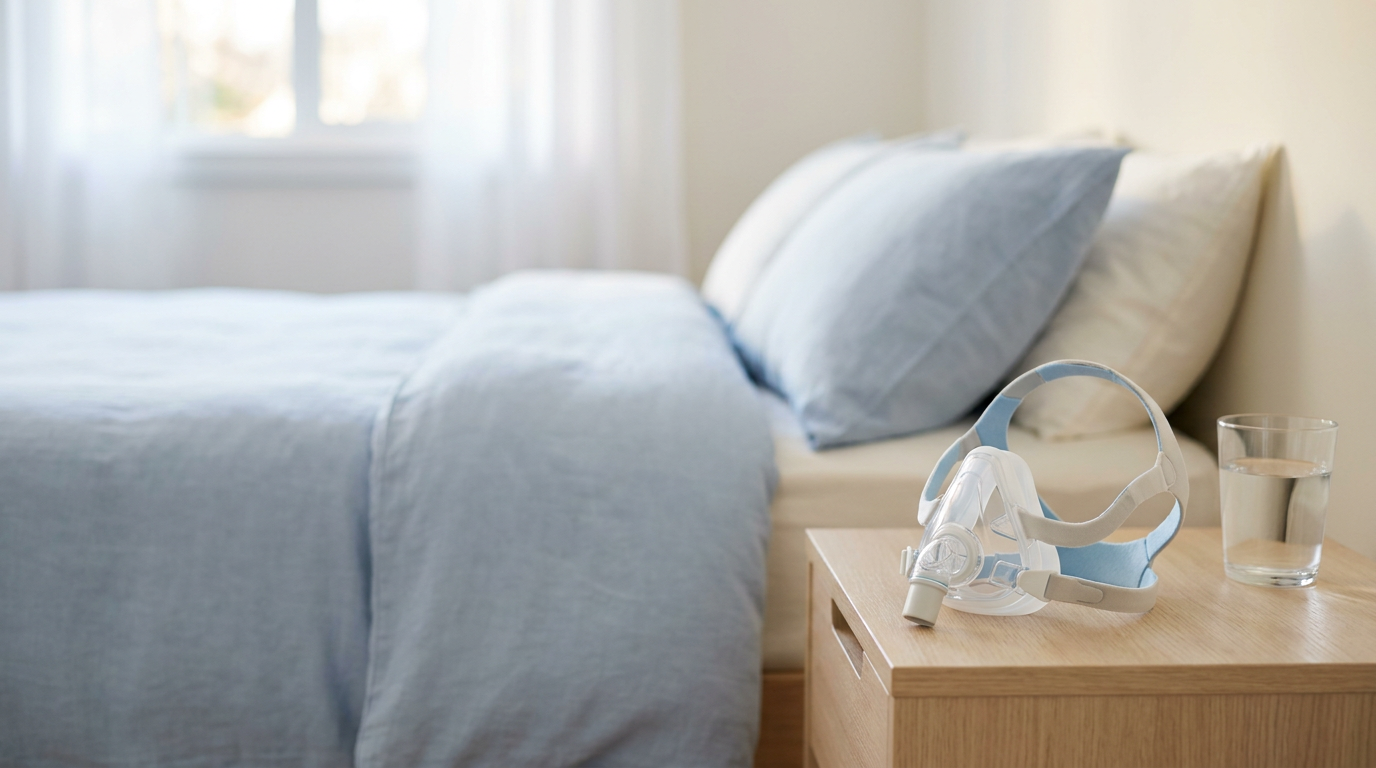
Sleep apnea steals your rest and leaves you tired all day. Zepbound® is a new option for some adults who live with obesity and this condition.
Maybe your partner hears you gasp at night. Maybe you wake up more tired than when you went to bed. That daily fog can feel impossible to shake.
You may have heard about a weight-loss shot that could also help you breathe better at night. Here is what the evidence shows, and what it does not.
It is not known if Zepbound® causes these tumors or medullary thyroid cancer (MTC) in people. Do not use it if you or a family member has had MTC. Do not use it if you have Multiple Endocrine Neoplasia syndrome type 2 (MEN 2).
Key takeaways
- Zepbound® (tirzepatide) is FDA-approved for moderate-to-severe obstructive sleep apnea in adults who also have obesity.
- The FDA approved this use on December 20, 2024, with a reduced-calorie diet and more activity.
- In SURMOUNT-OSA, Zepbound® cut sleep apnea events far more than placebo across two 52-week trials.
- It is approved for OSA with obesity, not for every kind of sleep apnea.
- Zepbound® does not replace CPAP or PAP; those choices stay between you and your clinician.
What this guide answers
- Is Zepbound® really FDA-approved for sleep apnea?
- How much did it lower sleep apnea events in trials?
- Who can take it, and who cannot?
- Does it replace my CPAP machine?
- What side effects and safety risks should I know?
Zepbound® and sleep apnea: the FDA approval
Zepbound® (tirzepatide) is a once-weekly shot. On December 20, 2024, the FDA approved it for moderate-to-severe obstructive sleep apnea in adults with obesity.
This was the first prescription medicine cleared for this use. It is meant to be used with a reduced-calorie diet and more physical activity.
The approval was based on a large research program in adults with obesity. It gives doctors a medicine option beyond machines and lifestyle steps alone.
How Zepbound® helps with obstructive sleep apnea
Obstructive sleep apnea happens when your airway keeps closing during sleep. Extra weight around the neck and belly can make this worse.
GIP and GLP-1 are natural hormones your gut makes after you eat. They tell your brain you are full and help control blood sugar.
Zepbound® (tirzepatide) mimics both of these signals at once. For many people, that leads to eating less and losing weight over months.
Losing weight can ease the load on your upper airway. With less soft tissue pressing on it, the airway may stay open more during sleep.
As weight comes down, the airway faces less pressure. That may lead to fewer breathing pauses at night.
Zepbound® is the first prescription medicine the FDA has cleared for moderate-to-severe obstructive sleep apnea in adults with obesity.
What SURMOUNT-OSA found
Researchers tested Zepbound® in a study program called SURMOUNT-OSA. It included two 52-week trials with 469 adults in total.
Everyone in the trials also followed a reduced-calorie diet and moved more. Study 1 enrolled people who did not use a PAP machine. Study 2 enrolled people who did use one.
Doctors measure sleep apnea with the apnea-hypopnea index (AHI). AHI counts how many times each hour your breathing stops or slows.
A lower AHI means fewer breathing pauses each hour. In both trials, Zepbound® lowered AHI much more than placebo.
In Study 1, for people not using a PAP machine, Zepbound® lowered AHI by about 27.4 events per hour. Placebo lowered it by about 4.8 events per hour.
In Study 2, for people using a PAP machine, Zepbound® lowered AHI by about 30.4 events per hour. Placebo lowered it by about 6.0 events per hour.
These numbers are averages across each group. Individual results vary from person to person.
For many people, fewer breathing pauses can mean deeper, calmer sleep. Better sleep may lift your energy during the day.
| SURMOUNT-OSA trial | Zepbound® mean AHI change | Placebo mean AHI change |
|---|---|---|
| Study 1 (not using PAP) | about -27.4 events/hour | about -4.8 events/hour |
| Study 2 (using PAP) | about -30.4 events/hour | about -6.0 events/hour |
AHI = apnea-hypopnea index (breathing events per hour). SURMOUNT-OSA, two 52-week trials, N=469 total.
These results apply only to the FDA-approved branded product Zepbound® and do not transfer to compounded tirzepatide. Compounded tirzepatide is not FDA-approved, is not a generic of Zepbound®, and is not evaluated by the FDA for safety, effectiveness, or quality.
Who Zepbound® is approved for
Zepbound® is approved for adults with obesity who also have moderate-to-severe obstructive sleep apnea. It is not approved for every person with sleep apnea.
Moderate-to-severe sleep apnea means your breathing stops or slows many times each hour. A sleep study measures this before treatment.
If your sleep apnea is not tied to weight, this medicine may not fit your situation. A clinician can check whether you qualify.
Zepbound®, diet, and activity work together
The FDA approved Zepbound® for sleep apnea alongside a reduced-calorie diet and more physical activity. The medicine is one part of the plan, not the whole plan.
Healthy meals and regular movement support your weight and your sleep. Small, steady changes tend to last longer than big, sudden ones.
Your care team can help you set goals that fit your life. They can also track how your sleep and energy change over time.
How Zepbound® is dosed for sleep apnea
Zepbound® is a shot you give yourself under the skin once a week. Your clinician starts low and raises the dose slowly.
The single-dose pens and vials come in six strengths. Your clinician picks the strength that matches your dose.
1. Weeks 1 to 4: start Zepbound® at 2.5 mg once weekly to help your body adjust.
2. After 4 weeks: move up to 5 mg once weekly.
3. Then raise by 2.5 mg at a time, no sooner than every 4 weeks, if needed.
4. For sleep apnea, the maintenance dose is 10 mg or 15 mg once weekly.
5. The most any adult takes is 15 mg once weekly.
If you miss a dose, take it within 4 days. If more than 4 days pass, skip it and take your next dose as planned.
Zepbound® is not a replacement for CPAP
CPAP and other PAP machines are standard tools for obstructive sleep apnea. Zepbound® does not replace them on its own.
CPAP works by keeping your airway open with gentle air pressure. It does not lower your weight, and Zepbound® does not blow air into your airway.
The two work in very different ways. For some people, a doctor may use them together for a time.
Any change to your CPAP or PAP plan should be made with your clinician. Do not stop your machine on your own.
For some people, losing weight may lower how much they rely on a machine over time. That is a decision to make together with your care team.
Zepbound® is not a replacement for CPAP. Any change to your machine belongs in a conversation with your clinician.
Side effects and safety to know
The most common side effects of Zepbound® affect the stomach and gut. These include nausea, diarrhea, constipation, and vomiting.
Most stomach side effects are mild and often fade as your body adjusts. Starting low and going slow with the dose helps many people.
Zepbound® also carries a boxed warning about thyroid C-cell tumors. Serious risks in the label include pancreatitis, gallbladder problems, and low blood sugar.
Tell your clinician about any health history before you start. Ask about warning signs and when to seek care.
Never share your pen or vial with anyone else. Store and handle the medicine the way your pharmacist explains.
How long before Zepbound® may help
The SURMOUNT-OSA trials ran for 52 weeks. Benefits build slowly as weight comes off week by week.
In the sleep apnea trials, people were treated for a full year. That gave the medicine and lifestyle changes time to add up.
There is no quick fix here. Give the medicine and your habits time to work together.
Weight and obesity are long-term conditions. If you stop the medicine, some weight may return, so plan next steps with your clinician.
What happens if you stop Zepbound®
Obesity is a long-term condition, and the weight can return if treatment stops. Researchers saw this in a withdrawal study called SURMOUNT-4.
In SURMOUNT-4, adults took Zepbound® for 36 weeks and lost about 20.9% of their weight on average. Then some switched to a placebo, and others kept taking Zepbound®.
The group that switched to placebo regained about 14.0% of their weight. The group that kept taking Zepbound® lost about 5.5% more. The study included 670 adults.
This shows why stopping is a choice to make with your clinician. There is no set taper or maintenance dose in the label, so plan ahead together.
Questions to ask your clinician
A short list of questions can make your visit easier. Bring these to your clinician when you talk about Zepbound®.
Do I have obesity and moderate-to-severe obstructive sleep apnea?
Is Zepbound® a good fit with my health history?
Should I keep using my CPAP or PAP machine?
What side effects should I watch for, and when should I call?
What is the plan if I need to stop the medicine?
How will we track my sleep, weight, and energy over time?
Living with sleep apnea and obesity
Sleep apnea and obesity often go hand in hand. Managing them together can help your rest, your mood, and your energy.
Better sleep can make it easier to stay active during the day. More activity can support your weight over time.
Progress often comes in small steps, not overnight. Be patient with yourself as your body adjusts.
You do not have to figure this out alone. A care team can guide each step, from diet to sleep testing to medicine.
Same medicine, different job: Zepbound® vs Mounjaro®
Zepbound® and Mounjaro® are both tirzepatide, the same active drug. They have different FDA-approved jobs.
Zepbound® is approved for weight management and for obstructive sleep apnea with obesity. Mounjaro® is approved to help adults with type 2 diabetes manage blood sugar.
The dose steps and the boxed warning are the same for both. What differs is the health problem each one is approved to help with.
Your clinician chooses the right brand for your diagnosis. Using the brand that matches your condition helps with access and coverage.
Zepbound® and Mounjaro® are the same medicine, tirzepatide, approved by the FDA for different jobs.
3. Malhotra A, et al. Tirzepatide for the treatment of obstructive sleep apnea and obesity (SURMOUNT-OSA). New England Journal of Medicine. 2024.
4. Eli Lilly and Company. Zepbound is the first and only prescription medicine approved for moderate-to-severe obstructive sleep apnea in adults with obesity. News release. December 20, 2024.
Frequently asked questions
Is Zepbound® FDA-approved for sleep apnea?
Yes. On December 20, 2024, the FDA approved Zepbound® (tirzepatide) for moderate-to-severe obstructive sleep apnea in adults who also have obesity. It is used with a reduced-calorie diet and more physical activity. It was the first prescription medicine cleared for this use. It is not approved for sleep apnea that is not tied to obesity.
How much does Zepbound® lower sleep apnea events?
In the SURMOUNT-OSA program, two 52-week trials enrolled 469 adults. Zepbound® lowered the apnea-hypopnea index by about 27.4 events per hour in Study 1, versus about 4.8 with placebo. In Study 2, it lowered AHI by about 30.4 events per hour, versus about 6.0 with placebo. These results are for the branded product only.
Does Zepbound® replace my CPAP machine?
No. Zepbound® does not replace CPAP or other PAP machines on its own. Those machines remain standard care for obstructive sleep apnea. For some people, weight loss may change how much they rely on a machine over time. Any change to your CPAP or PAP plan should be made with your clinician, not on your own.
What dose of Zepbound® is used for sleep apnea?
Zepbound® is a once-weekly shot under the skin. Most people start at 2.5 mg for four weeks to adjust, then move to 5 mg. The dose can rise by 2.5 mg at a time, no sooner than every four weeks. For sleep apnea, the maintenance dose is 10 mg or 15 mg once weekly. The most any adult takes is 15 mg.
What are the most common side effects of Zepbound®?
The most common side effects of Zepbound® affect the stomach and gut. They include nausea, diarrhea, constipation, and vomiting. These often ease as your body adjusts. The label also lists more serious risks, such as pancreatitis, gallbladder problems, and low blood sugar. Zepbound® carries a boxed warning about thyroid C-cell tumors. Tell your clinician your full health history first.
Is Zepbound® the same as Mounjaro®?
Zepbound® and Mounjaro® contain the same active drug, tirzepatide. They have different FDA-approved jobs. Zepbound® is approved for chronic weight management and for obstructive sleep apnea in adults with obesity. Mounjaro® is approved to help adults with type 2 diabetes manage their blood sugar. Your clinician chooses based on your diagnosis and needs.
How do I get Zepbound® for sleep apnea?
Zepbound® is a prescription medicine, so you need a clinician to evaluate you. They will confirm whether you have obesity and moderate-to-severe obstructive sleep apnea. Coverage and access vary by provider and plan, and no insurance is required with some options. Talk to your doctor about whether Zepbound® fits your health and your goals.
Can Zepbound® cure obstructive sleep apnea?
No medicine cures obstructive sleep apnea. In the SURMOUNT-OSA trials, Zepbound® lowered the number of breathing events per hour for many adults with obesity. It is a long-term tool used with a reduced-calorie diet and more activity, not a one-time fix. Work with your clinician on a plan that fits your health and your goals.
Keep reading
Obesity: treatment options
See how obesity is treated today, from lifestyle steps to FDA-approved medicines, and where options like Zepbound® fit in.
Read more →Important: This page is for education only and is not medical advice. Any medicines named here are available by prescription. Always talk to a licensed clinician about medicines, symptoms, or anything you are considering.
Related data
- When generic tirzepatide arrives →FDA patent and exclusivity expiry dates
- Tirzepatide clinical trials →Registered studies, phases and status
- FDA drug shortage tracker →Which peptide drugs are in shortage now, with the FDA-stated cause
- Which peptides are FDA-approved →Approval status for every peptide, from Drugs@FDA
More from Peptides.io
- GLP-1 Treatment Gap Index →Our analysis of where Medicaid access to GLP-1s falls shortest, by state
- Original research from Peptides.io →Data reports we produce ourselves



Comments