
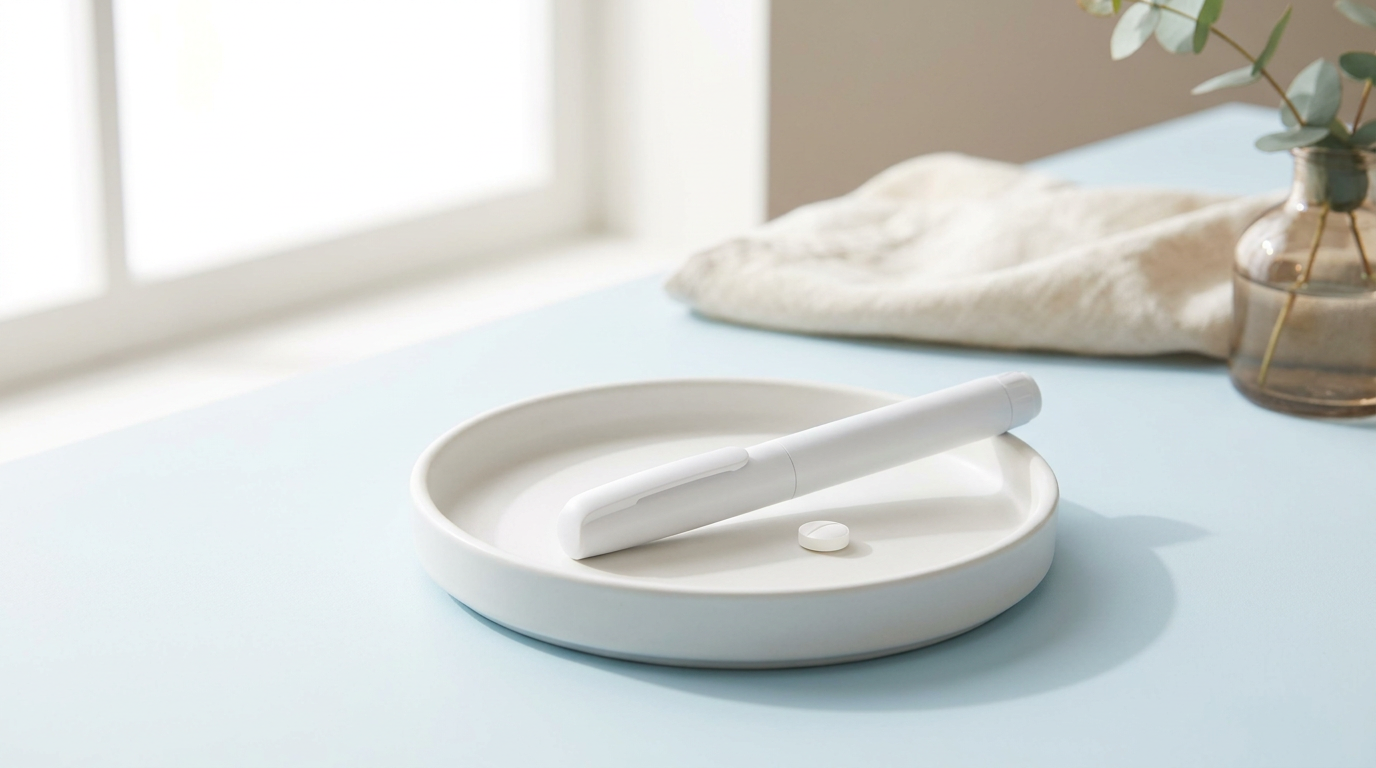
If you are comparing Ozempic® vs Rybelsus®, you are probably tired of guessing which one fits your day. I get it. The choice feels bigger than it should.
Both are real medicines for type 2 diabetes. One is a weekly shot. The other is a daily pill.
You want a clear answer, not a sales pitch. So let me lay out what each brand is, how you take it, and what the labels say.
Key takeaways
- Ozempic® and Rybelsus® are both semaglutide brands approved for type 2 diabetes.
- Ozempic® is a once-weekly injection; Rybelsus® is a once-daily tablet you swallow.
- Rybelsus® must be taken on an empty stomach with up to 4 oz of plain water.
- In SUSTAIN 1, Ozempic® at 1 mg lowered A1c about 1.6% over 30 weeks.
- Both carry a boxed warning for thyroid C-cell tumors; watch for severe belly pain.
What this guide answers
- Are Ozempic® and Rybelsus® the same medicine in different forms?
- Is it better to take a weekly shot or a daily pill?
- How do you take Rybelsus® the right way?
- What do the diabetes trials actually show?
- Which one fits your routine and comfort level?
What Ozempic® and Rybelsus® actually are
Here is the simple version. Both Ozempic® and Rybelsus® are brands of semaglutide. Both are approved for adults with type 2 diabetes.
The active ingredient is the same. What changes is the form and how you take it.
That shared drug is good news for you. It means both brands rest on the very same medicine, just delivered in different ways.
Ozempic® comes as a once-weekly injection under the skin. Rybelsus® is the oral form, taken as a tablet once a day.
So they are close cousins, not twins. The medicine inside matches, but the way it reaches your body does not.
Semaglutide belongs to a group called GLP-1 medicines. These copy a gut hormone that helps your body handle blood sugar after meals.
So the big question for you is not really the molecule. It is the delivery, and how that fits your daily life.
Here is why that matters. Two people with the same diagnosis can need very different routines.
One person travels a lot and hates needles. Another just wants the fewest doses possible. The right brand can differ for each.
Ozempic® and Rybelsus® are both semaglutide. What sets them apart is the form, weekly shot or daily pill.
Injection or tablet? How you take each one
Ozempic® goes in as a shot under the skin, once a week. You can use the belly, thigh, or upper arm.
With Ozempic®, you use a prefilled pen. You dial the dose, press, and hold for a few seconds.
Many people like a weekly rhythm. You dose one day a week and then move on.
Rybelsus® trades that weekly shot for a daily habit. There are no needles, which some people strongly prefer.
Rybelsus® asks for more care each morning. The label is strict, and that detail matters for how well the pill works.
Here is how the Rybelsus® label says to take it each day:
1. Take Rybelsus® first thing after waking, on an empty stomach.
2. Swallow the tablet whole with up to 4 oz (120 mL) of plain water.
3. Wait at least 30 minutes before you eat, drink, or take other pills.
4. Do not split, crush, or chew the Rybelsus® tablet.
That 30 minute wait is the part people forget. Food or extra water too soon can lower how much medicine you absorb.
Timing is everything with the tablet. Take it with a full breakfast, and your body may absorb far less of the dose.
A weekly shot skips this daily step. That is a real difference if your mornings are busy.
For a lot of people, the choice comes down to one word. Needles.
If a weekly shot does not bother you, Ozempic® is simple. If it does, the daily pill removes that hurdle entirely.
Consistency is the quiet winner here. The form you can repeat without fuss is often the form that helps you most.
The daily Rybelsus® routine is strict. Empty stomach, up to 4 oz of water, then wait 30 minutes before anything else.
How the doses step up
Both brands start low and climb slowly. This gentle start gives your body time to adjust and can ease side effects.
Ozempic® starts at 0.25 mg once a week for 4 weeks. That first dose sets you up but does not control blood sugar on its own.
After that, Ozempic® moves to 0.5 mg, then 1 mg, with at least 4 weeks between steps. The most the label allows is 2 mg once a week.
Rybelsus® begins at 3 mg once a day for 30 days. Like Ozempic®, this starter dose is about tolerance, not blood sugar control.
After 30 days, Rybelsus® goes to 7 mg. If you need more, the label allows 14 mg after at least another 30 days.
Why the slow climb? A high starting dose can upset your stomach. Stepping up gives your gut time to settle.
Do not rush the schedule on your own. Your prescriber decides when you are ready to move up, based on how you feel.
Both timelines share the same logic. Start small, wait, then step up only when your body is ready.
What the diabetes trials show
Let me stick to what the labels report, and only for blood sugar. I will not stretch these numbers into weight loss claims, because that is not what these two brands are for.
First, a quick word on A1c. It is a blood test that shows your average blood sugar over about three months.
A lower A1c usually means steadier control. That is the number these diabetes trials care about most.
In SUSTAIN 1, researchers tested Ozempic® on its own in 388 adults with type 2 diabetes. Their average A1c at the start was about 8 percent.
Over 30 weeks, Ozempic® at 0.5 mg lowered A1c by about 1.4 percent. At 1 mg, Ozempic® lowered A1c by about 1.6 percent.
Placebo lowered A1c by only about 0.1 percent in the same trial. So the drop with Ozempic® was clearly larger.
I do not have a head-to-head trial that pits these two brands against each other. So I will not pretend one exists.
What I can say is that Rybelsus® is FDA-approved to improve blood sugar in adults with type 2 diabetes. That approval is the key fact for this comparison.
I want to be straight with you here. A cleaner comparison would need both brands tested side by side.
Until that trial is in front of me, the honest move is to report each brand on its own terms.
| Brand | Form and how you take it | Dose steps | FDA-approved use | Trial evidence (A1c) |
|---|---|---|---|---|
| Ozempic® (brand of semaglutide) | Once-weekly injection under the skin | 0.25 mg for 4 weeks, then 0.5 mg, then 1 mg, up to 2 mg max | Type 2 diabetes | SUSTAIN 1, n=388: A1c fell about 1.6% at 1 mg over 30 weeks |
| Rybelsus® (brand of oral semaglutide) | Once-daily tablet, empty stomach, up to 4 oz water, wait 30 min | 3 mg for 30 days, then 7 mg, may increase to 14 mg | Type 2 diabetes | FDA-approved for type 2 diabetes; no head-to-head trial in these sources |
Both brands are semaglutide for type 2 diabetes; the real split is weekly injection versus daily tablet.
Side effects and safety worth watching
No honest comparison skips the risks. Both brands share the same safety profile, because the medicine inside is the same.
Both carry a boxed warning for thyroid C-cell tumors, noted at the top of this page. That warning is the most serious one on the label.
Both labels also warn about acute pancreatitis. Signs include severe belly pain that may spread to your back, with or without vomiting.
If you notice that pain, stop the medicine and get care right away. Do not wait to see if it passes.
Milder stomach upset is common with GLP-1 medicines. Nausea often eases as your body adjusts to each dose step.
Talk with your prescriber about your full history before you start either brand. Some conditions make one option safer than the other.
Report any new or lasting symptom, even one that seems small. Your care team would rather hear about it early than late.
None of this should scare you off. It is simply the honest fine print behind a medicine that helps many people.
Your prescriber has heard these questions many times. Lean on them, and ask anything that worries you.
Ozempic® vs Rybelsus®: which fits your life?
Here is my honest take, based on the labels, not on hype. The best form is the one you will actually stick with.
If you would rather think about your medicine once a week, Ozempic® makes that easy. One shot, and you are done until next week.
If needles are a dealbreaker, Rybelsus® gives you a pill instead. The trade is a strict daily routine you cannot skip.
Ask yourself one honest question. Can you protect that empty-stomach, 30 minute window every single morning?
If yes, the tablet may suit you. If mornings are chaos, the weekly shot may be kinder to your routine.
Think about your real week, not your ideal one. Pick the form you can keep up with on your busiest, most tired days.
The best brand is the one you will actually take. For some that is a weekly shot, for others a daily pill.
Before you decide between Ozempic® and Rybelsus®, bring these questions to your prescriber:
1. Which form fits my routine, a weekly Ozempic® shot or a daily Rybelsus® tablet?
2. Can I realistically protect the Rybelsus® empty-stomach window each morning?
3. What starting dose is right for me, and when might it step up?
4. Does my health history point toward one brand over the other?
Whatever you choose, consistency beats perfection. A dose you take every time works better than a stronger plan you skip.
Neither choice is better on paper. Your prescriber will match the form and the dose to your health and your day.
Frequently asked questions
Are Ozempic® and Rybelsus® the same drug?
They are both semaglutide, and both are approved for type 2 diabetes. The difference is the form. Ozempic® is a once-weekly injection you give under the skin. Rybelsus® is a once-daily tablet you swallow. So think of them as the same medicine delivered two different ways, not as two separate drugs.
Is Rybelsus® just Ozempic® in pill form?
In a sense, yes. Both are semaglutide, and both are approved for type 2 diabetes. Rybelsus® is the oral tablet version, while Ozempic® is the weekly injection. The pill needs a strict routine, though. You take Rybelsus® on an empty stomach with a little water, then wait 30 minutes before anything else.
How do I take Rybelsus® correctly?
Take Rybelsus® first thing after you wake, on an empty stomach. Swallow one tablet whole with up to 4 oz, or 120 mL, of plain water. Then wait at least 30 minutes before you eat, drink, or take other pills. Do not split, crush, or chew it. This routine helps your body absorb the medicine.
Is Ozempic® or Rybelsus® approved for weight loss?
No. Both Ozempic® and Rybelsus® are approved for type 2 diabetes, not for weight loss. Rybelsus® is a diabetes tablet, not a diet pill. Wegovy® is the semaglutide brand that is FDA-approved for chronic weight management. If weight is your goal, talk with a clinician about which brand and plan fit your health.
Which lowers A1c more, Ozempic® or Rybelsus®?
My sources do not include a head-to-head trial of the two brands, so I will not guess. What I can report is Ozempic®. In SUSTAIN 1, with 388 adults, Ozempic® at 1 mg lowered A1c by about 1.6 percent over 30 weeks. Placebo lowered it by about 0.1 percent. Your prescriber can guide the choice.
What are the main side effects of Ozempic® and Rybelsus®?
Because both are semaglutide, they share a safety profile. Milder stomach upset, like nausea, is common and often eases with each dose step. Both labels warn about acute pancreatitis. Signs include severe belly pain that may spread to the back, with or without vomiting. If that happens, stop the medicine and get care right away.
Can I switch between Ozempic® and Rybelsus®?
That is a decision for your prescriber, not something to try on your own. Both brands are semaglutide, but the injection and the tablet use different dose steps. A clinician can map a safe switch and set the right starting dose. They will also weigh your blood sugar goals, your routine, and how well you tolerate each form.
Keep reading
Keep reading: how to choose a GLP-1 provider
Ready to compare where and how to get semaglutide? See how the top GLP-1 providers stack up on real operational factors.
Read more →Important: This page is for education only and is not medical advice. Any medicines named here are available by prescription. Always talk to a licensed clinician about medicines, symptoms, or anything you are considering.
Related data
- When generic semaglutide arrives →FDA patent and exclusivity expiry dates
- Semaglutide clinical trials →Registered studies, phases and status
- FDA drug shortage tracker →Which peptide drugs are in shortage now, with the FDA-stated cause
- Which peptides are FDA-approved →Approval status for every peptide, from Drugs@FDA
More from Peptides.io
- GLP-1 Treatment Gap Index →Our analysis of where Medicaid access to GLP-1s falls shortest, by state
- Original research from Peptides.io →Data reports we produce ourselves



Comments